


Page 352 - Elementary_Linear_Algebra_with_Applications_Anton__9_edition
P. 352
Remark A set W of one or more vectors from a vector space V is said to be closed under addition if condition (a) in
Theorem 5.2.1 holds and closed under scalar multiplication if condition (b) holds. Thus Theorem 5.2.1 states that W is a
subspace of V if and only if W is closed under addition and closed under scalar multiplication.

EXAMPLE 1 Testing for a Subspace

In Example 6 of Section 5.1 we verified the ten vector space axioms to show that the points in a plane through the origin of

form a subspace of . In light of Theorem 5.2.1 we can see that much of that work was unnecessary; it would have been

sufficient to verify that the plane is closed under addition and scalar multiplication (Axioms 1 and 6). In Section 5.1 we

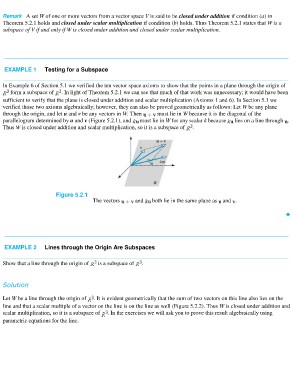
verified those two axioms algebraically; however, they can also be proved geometrically as follows: Let W be any plane

through the origin, and let u and v be any vectors in W. Then  must lie in W because it is the diagonal of the

parallelogram determined by u and v (Figure 5.2.1), and must lie in W for any scalar k because lies on a line through .

Thus W is closed under addition and scalar multiplication, so it is a subspace of .

Figure 5.2.1                      and both lie in the same plane as and .
                   The vectors

EXAMPLE 2 Lines through the Origin Are Subspaces

Show that a line through the origin of is a subspace of .

Solution

Let W be a line through the origin of . It is evident geometrically that the sum of two vectors on this line also lies on the
line and that a scalar multiple of a vector on the line is on the line as well (Figure 5.2.2). Thus W is closed under addition and
scalar multiplication, so it is a subspace of . In the exercises we will ask you to prove this result algebraically using
parametric equations for the line.

