


Page 407 - Elementary_Linear_Algebra_with_Applications_Anton__9_edition
P. 407
is called the general solution of  , and the expression                                  is called the
                                                                                                 is the sum of any particular
general solution of  . With this terminology, Formula 3 states that the general solution of

solution of  and the general solution of       .

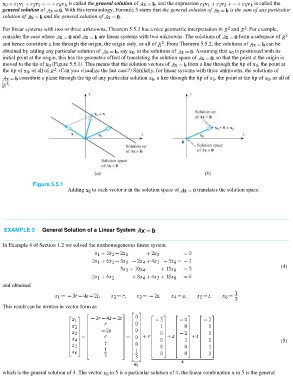
For linear systems with two or three unknowns, Theorem 5.5.2 has a nice geometric interpretation in and . For example,

consider the case where and are linear systems with two unknowns. The solutions of form a subspace of

and hence constitute a line through the origin, the origin only, or all of . From Theorem 5.5.2, the solutions of                can be

obtained by adding any particular solution of  , say , to the solutions of        . Assuming that is positioned with its

initial point at the origin, this has the geometric effect of translating the solution space of  , so that the point at the origin is

moved to the tip of (Figure 5.5.1). This means that the solution vectors of       form a line through the tip of , the point at

the tip of , or all of . (Can you visualize the last case?) Similarly, for linear systems with three unknowns, the solutions of

   constitute a plane through the tip of any particular solution , a line through the tip of , the point at the tip of , or all of

.

             Figure 5.5.1                                                                        translates the solution space.
                                Adding to each vector x in the solution space of

EXAMPLE 3 General Solution of a Linear System                                                                                            (4)
In Example 4 of Section 1.2 we solved the nonhomogeneous linear system

and obtained
This result can be written in vector form as

                                                                                                                                                          (5)
which is the general solution of 4. The vector in 5 is a particular solution of 4; the linear combination x in 5 is the general

