


Page 41 - Elementary_Linear_Algebra_with_Applications_Anton__9_edition
P. 41
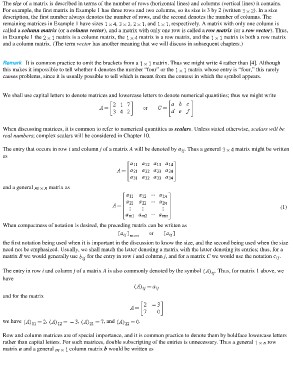
The size of a matrix is described in terms of the number of rows (horizontal lines) and columns (vertical lines) it contains.
For example, the first matrix in Example 1 has three rows and two columns, so its size is 3 by 2 (written ). In a size
description, the first number always denotes the number of rows, and the second denotes the number of columns. The
remaining matrices in Example 1 have sizes , , , and , respectively. A matrix with only one column is
called a column matrix (or a column vector), and a matrix with only one row is called a row matrix (or a row vector). Thus,
in Example 1 the matrix is a column matrix, the matrix is a row matrix, and the matrix is both a row matrix
and a column matrix. (The term vector has another meaning that we will discuss in subsequent chapters.)

Remark It is common practice to omit the brackets from a matrix. Thus we might write 4 rather than [4]. Although
this makes it impossible to tell whether 4 denotes the number “four” or the matrix whose entry is “four,” this rarely
causes problems, since it is usually possible to tell which is meant from the context in which the symbol appears.

We shall use capital letters to denote matrices and lowercase letters to denote numerical quantities; thus we might write

When discussing matrices, it is common to refer to numerical quantities as scalars. Unless stated otherwise, scalars will be
real numbers; complex scalars will be considered in Chapter 10.

The entry that occurs in row i and column j of a matrix A will be denoted by . Thus a general  matrix might be written
as

and a general          matrix as

                                                                                                                       (1)

When compactness of notation is desired, the preceding matrix can be written as

the first notation being used when it is important in the discussion to know the size, and the second being used when the size
need not be emphasized. Usually, we shall match the letter denoting a matrix with the letter denoting its entries; thus, for a
matrix B we would generally use for the entry in row i and column j, and for a matrix C we would use the notation .

The entry in row i and column j of a matrix A is also commonly denoted by the symbol  . Thus, for matrix 1 above, we
have

and for the matrix

we have             ,             , , and .

Row and column matrices are of special importance, and it is common practice to denote them by boldface lowercase letters

rather than capital letters. For such matrices, double subscripting of the entries is unnecessary. Thus a general row

matrix a and a general  column matrix b would be written as

