


Page 44 - Elementary_Linear_Algebra_with_Applications_Anton__9_edition
P. 44
is the linear combination of A, B, and C with scalar coefficients 2, −1, and .

Thus far we have defined multiplication of a matrix by a scalar but not the multiplication of two matrices. Since matrices are
added by adding corresponding entries and subtracted by subtracting corresponding entries, it would seem natural to define
multiplication of matrices by multiplying corresponding entries. However, it turns out that such a definition would not be
very useful for most problems. Experience has led mathematicians to the following more useful definition of matrix
multiplication.

            DEFINITION

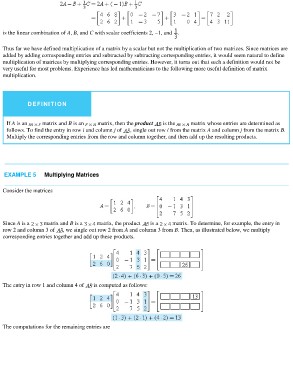
If A is an  matrix and B is an matrix, then the product is the  matrix whose entries are determined as

follows. To find the entry in row i and column j of , single out row i from the matrix A and column j from the matrix B.

Multiply the corresponding entries from the row and column together, and then add up the resulting products.

EXAMPLE 5 Multiplying Matrices
Consider the matrices

Since A is a matrix and B is a matrix, the product is a matrix. To determine, for example, the entry in
row 2 and column 3 of , we single out row 2 from A and column 3 from B. Then, as illustrated below, we multiply
corresponding entries together and add up these products.

The entry in row 1 and column 4 of is computed as follows:
The computations for the remaining entries are

