


Page 414 - Elementary_Linear_Algebra_with_Applications_Anton__9_edition
P. 414
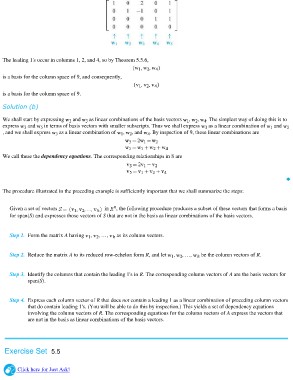
The leading 1's occur in columns 1, 2, and 4, so by Theorem 5.5.6,

is a basis for the column space of 9, and consequently,

is a basis for the column space of 9.

Solution (b)

We shall start by expressing and as linear combinations of the basis vectors , , . The simplest way of doing this is to
express and in terms of basis vectors with smaller subscripts. Thus we shall express as a linear combination of and
, and we shall express as a linear combination of , , and . By inspection of 9, these linear combinations are

We call these the dependency equations. The corresponding relationships in 8 are

The procedure illustrated in the preceding example is sufficiently important that we shall summarize the steps:

Given a set of vectors           in , the following procedure produces a subset of these vectors that forms a basis

for span(S) and expresses those vectors of S that are not in the basis as linear combinations of the basis vectors.

Step 1. Form the matrix A having , , …, as its column vectors.

Step 2. Reduce the matrix A to its reduced row-echelon form R, and let , , …, be the column vectors of R.

Step 3. Identify the columns that contain the leading 1's in R. The corresponding column vectors of A are the basis vectors for
          span(S).

Step 4. Express each column vector of R that does not contain a leading 1 as a linear combination of preceding column vectors
          that do contain leading 1's. (You will be able to do this by inspection.) This yields a set of dependency equations
          involving the column vectors of R. The corresponding equations for the column vectors of A express the vectors that
          are not in the basis as linear combinations of the basis vectors.

Exercise Set 5.5

       Click here for Just Ask!

