


Page 426 - Elementary_Linear_Algebra_with_Applications_Anton__9_edition
P. 426
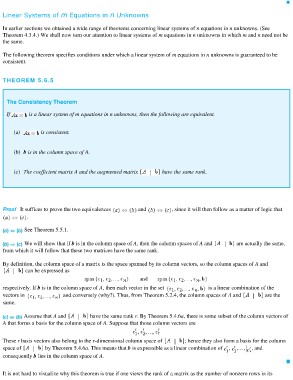
Linear Systems of m Equations in n Unknowns

In earlier sections we obtained a wide range of theorems concerning linear systems of n equations in n unknowns. (See
Theorem 4.3.4.) We shall now turn our attention to linear systems of m equations in n unknowns in which m and n need not be
the same.

The following theorem specifies conditions under which a linear system of m equations in n unknowns is guaranteed to be
consistent.

THEOREM 5.6.5

The Consistency Theorem
If is a linear system of m equations in n unknowns, then the following are equivalent.

   (a) is consistent.

(b) b is in the column space of A.

(c) The coefficient matrix A and the augmented matrix  have the same rank.

Proof It suffices to prove the two equivalences        and , since it will then follow as a matter of logic that
            .

          See Theorem 5.5.1.

           We will show that if b is in the column space of A, then the column spaces of A and  are actually the same,
from which it will follow that these two matrices have the same rank.

By definition, the column space of a matrix is the space spanned by its column vectors, so the column spaces of A and
            can be expressed as

respectively. If b is in the column space of A, then each vector in the set            is a linear combination of the

vectors in  and conversely (why?). Thus, from Theorem 5.2.4, the column spaces of A and                 are the

same.

          Assume that A and         have the same rank r. By Theorem 5.4.6a, there is some subset of the column vectors of

A that forms a basis for the column space of A. Suppose that those column vectors are

These r basis vectors also belong to the r-dimensional column space of       ; hence they also form a basis for the column

space of    by Theorem 5.4.6a. This means that b is expressible as a linear combination of , ,…, , and

consequently b lies in the column space of A.

It is not hard to visualize why this theorem is true if one views the rank of a matrix as the number of nonzero rows in its

