


Page 466 - Elementary_Linear_Algebra_with_Applications_Anton__9_edition
P. 466
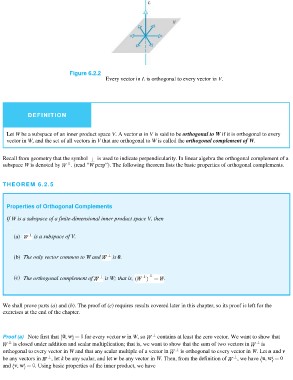
Figure 6.2.2
                                              Every vector in L is orthogonal to every vector in V.

             DEFINITION

  Let W be a subspace of an inner product space V. A vector u in V is said to be orthogonal to W if it is orthogonal to every
  vector in W, and the set of all vectors in V that are orthogonal to W is called the orthogonal complement of W.

Recall from geometry that the symbol is used to indicate perpendicularity. In linear algebra the orthogonal complement of a
subspace W is denoted by . (read “W perp”). The following theorem lists the basic properties of orthogonal complements.

THEOREM 6.2.5

Properties of Orthogonal Complements
If W is a subspace of a finite-dimensional inner product space V, then

   (a) is a subspace of V.

(b) The only vector common to W and is 0.

(c) The orthogonal complement of is W; that is,                         .

We shall prove parts (a) and (b). The proof of (c) requires results covered later in this chapter, so its proof is left for the
exercises at the end of the chapter.

Proof (a) Note first that  for every vector w in W, so contains at least the zero vector. We want to show that

is closed under addition and scalar multiplication; that is, we want to show that the sum of two vectors in is

orthogonal to every vector in W and that any scalar multiple of a vector in is orthogonal to every vector in W. Let u and v

be any vectors in , let k be any scalar, and let w be any vector in W. Then, from the definition of , we have

and . Using basic properties of the inner product, we have

