


Page 463 - Elementary_Linear_Algebra_with_Applications_Anton__9_edition
P. 463
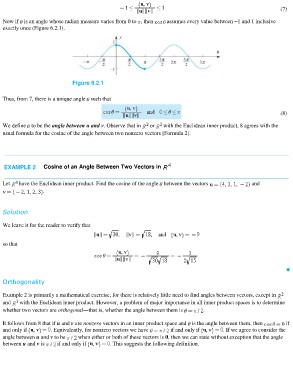
Now if is an angle whose radian measure varies from 0 to , then                                                               (7)
exactly once (Figure 6.2.1).                                     assumes every value between −1 and 1 inclusive

                                     Figure 6.2.1

Thus, from 7, there is a unique angle such that

                                                                                                                                                     (8)
We define to be the angle between u and v. Observe that in or with the Euclidean inner product, 8 agrees with the
usual formula for the cosine of the angle between two nonzero vectors [Formula 2].

EXAMPLE 2 Cosine of an Angle Between Two Vectors in                                     and
Let have the Euclidean inner product. Find the cosine of the angle between the vectors

                     .

Solution

We leave it for the reader to verify that

so that

Orthogonality

Example 2 is primarily a mathematical exercise, for there is relatively little need to find angles between vectors, except in

and with the Euclidean inner product. However, a problem of major importance in all inner product spaces is to determine

whether two vectors are orthogonal—that is, whether the angle between them is    .

It follows from 8 that if u and v are nonzero vectors in an inner product space and is the angle between them, then            if

and only if    . Equivalently, for nonzero vectors we have       if and only if         . If we agree to consider the

angle between u and v to be when either or both of these vectors is 0, then we can state without exception that the angle

between u and v is if and only if  . This suggests the following definition.

