


Page 567 - Elementary_Linear_Algebra_with_Applications_Anton__9_edition
P. 567
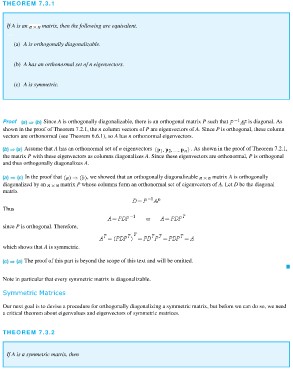
THEOREM 7.3.1
  If A is an matrix, then the following are equivalent.
     (a) A is orthogonally diagonalizable.
     (b) A has an orthonormal set of n eigenvectors.
     (c) A is symmetric.

Proof   Since A is orthogonally diagonalizable, there is an orthogonal matrix P such that  is diagonal. As

shown in the proof of Theorem 7.2.1, the n column vectors of P are eigenvectors of A. Since P is orthogonal, these column

vectors are orthonormal (see Theorem 6.6.1), so A has n orthonormal eigenvectors.

        Assume that A has an orthonormal set of n eigenvectors  . As shown in the proof of Theorem 7.2.1,

the matrix P with these eigenvectors as columns diagonalizes A. Since these eigenvectors are orthonormal, P is orthogonal

and thus orthogonally diagonalizes A.

        In the proof that          , we showed that an orthogonally diagonalizable matrix A is orthogonally

diagonalized by an matrix P whose columns form an orthonormal set of eigenvectors of A. Let D be the diagonal

matrix

Thus

since P is orthogonal. Therefore,

which shows that A is symmetric.
           The proof of this part is beyond the scope of this text and will be omitted.

Note in particular that every symmetric matrix is diagonalizable.

Symmetric Matrices

Our next goal is to devise a procedure for orthogonally diagonalizing a symmetric matrix, but before we can do so, we need
a critical theorem about eigenvalues and eigenvectors of symmetric matrices.

THEOREM 7.3.2

If A is a symmetric matrix, then

