


Page 619 - Elementary_Linear_Algebra_with_Applications_Anton__9_edition
P. 619
8.4                  In this section we shall show that if V and W are finite-dimensional vector

MATRICES OF GENERAL  spaces (not necessarily and ), then with a little ingenuity any linear
LINEAR
TRANSFORMATIONS      transformation                         can be regarded as a matrix transformation. The

                     basic idea is to work with coordinate vectors rather than with the vectors

                     themselves.

Matrices of Linear Transformations

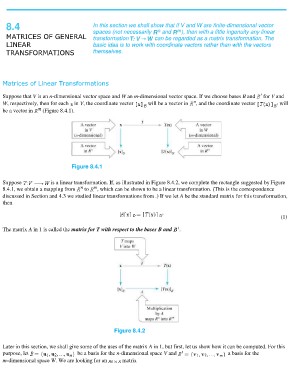
Suppose that V is an n-dimensional vector space and W an m-dimensional vector space. If we choose bases B and  for V and
W, respectively, then for each in V, the coordinate vector will be a vector in , and the coordinate vector             will
be a vector in (Figure 8.4.1).

              Figure 8.4.1

Suppose       is a linear transformation. If, as illustrated in Figure 8.4.2, we complete the rectangle suggested by Figure

8.4.1, we obtain a mapping from to , which can be shown to be a linear transformation. (This is the correspondence

discussed in Section and 4.3 we studied linear transformations from .) If we let A be the standard matrix for this transformation,

then

                                                                                                                    (1)

The matrix A in 1 is called the matrix for T with respect to the bases B and .

                                              Figure 8.4.2

Later in this section, we shall give some of the uses of the matrix A in 1, but first, let us show how it can be computed. For this

purpose, let  be a basis for the n-dimensional space V and                      a basis for the

m-dimensional space W. We are looking for an  matrix

