


Page 652 - Elementary_Linear_Algebra_with_Applications_Anton__9_edition
P. 652
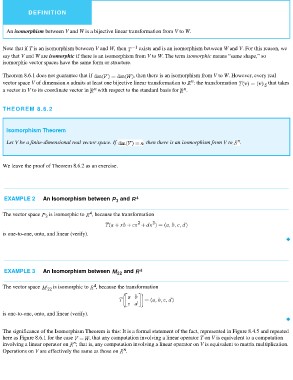
DEFINITION

An isomorphism between V and W is a bijective linear transformation from V to W.

Note that if T is an isomorphism between V and W, then exists and is an isomorphism between W and V. For this reason, we

say that V and W are isomorphic if there is an isomorphism from V to W. The term isomorphic means “same shape,” so
isomorphic vector spaces have the same form or structure.

Theorem 8.6.1 does not guarantee that if                , then there is an isomorphism from V to W. However, every real

vector space V of dimension n admits at least one bijective linear transformation to : the transformation  that takes

a vector in V to its coordinate vector in with respect to the standard basis for .

THEOREM 8.6.2

Isomorphism Theorem                                     , then there is an isomorphism from V to .
Let V be a finite-dimensional real vector space. If

We leave the proof of Theorem 8.6.2 as an exercise.

EXAMPLE 2 An Isomorphism between and
The vector space is isomorphic to , because the transformation
is one-to-one, onto, and linear (verify).

EXAMPLE 3 An Isomorphism between and
The vector space is isomorphic to , because the transformation

is one-to-one, onto, and linear (verify).

The significance of the Isomorphism Theorem is this: It is a formal statement of the fact, represented in Figure 8.4.5 and repeated

here as Figure 8.6.1 for the case          , that any computation involving a linear operator T on V is equivalent to a computation

involving a linear operator on ; that is, any computation involving a linear operator on V is equivalent to matrix multiplication.

Operations on V are effectively the same as those on .

