


Page 654 - Elementary_Linear_Algebra_with_Applications_Anton__9_edition
P. 654
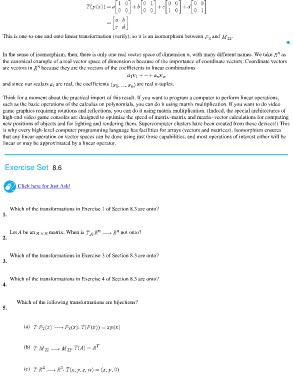
This is one-to-one and onto linear transformation (verify), so it is an isomorphism between and .

In the sense of isomorphism, then, there is only one real vector space of dimension n, with many different names. We take as
the canonical example of a real vector space of dimension n because of the importance of coordinate vectors. Coordinate vectors
are vectors in because they are the vectors of the coefficients in linear combinations

and since our scalars are real, the coefficients  are real n-tuples.

Think for a moment about the practical import of this result. If you want to program a computer to perform linear operations,
such as the basic operations of the calculus on polynomials, you can do it using matrix multiplication. If you want to do video
game graphics requiring rotations and reflections, you can do it using matrix multiplication. (Indeed, the special architectures of
high-end video game consoles are designed to optimize the speed of matrix–matrix and matrix–vector calculations for computing
new positions of objects and for lighting and rendering them. Supercomputer clusters have been created from these devices!) This
is why every high-level computer programming language has facilities for arrays (vectors and matrices). Isomorphism ensures
that any linear operation on vector spaces can be done using just those capabilities, and most operations of interest either will be
linear or may be approximated by a linear operator.

Exercise Set 8.6

       Click here for Just Ask!

   Which of the transformations in Exercise 1 of Section 8.3 are onto?
1.

   Let A be an  matrix. When is                   not onto?
2.

   Which of the transformations in Exercise 3 of Section 8.3 are onto?
3.

   Which of the transformations in Exercise 4 of Section 8.3 are onto?
4.

       Which of the following transformations are bijections?
5.

(a) ,

(b) ,

(c) ,

