


Page 679 - Elementary_Linear_Algebra_with_Applications_Anton__9_edition
P. 679
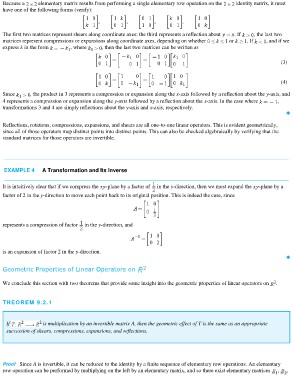
Because a elementary matrix results from performing a single elementary row operation on the            identity matrix, it must
have one of the following forms (verify):

The first two matrices represent shears along coordinate axes; the third represents a reflection about    . If , the last two
                                                                                                        or . If , and if we
matrices represent compressions or expansions along coordinate axes, depending on whether

express k in the form  , where  , then the last two matrices can be written as

                                                                                                                                     (3)

                                                                                                                                     (4)

Since  , the product in 3 represents a compression or expansion along the x-axis followed by a reflection about the y-axis, and

4 represents a compression or expansion along the y-axis followed by a reflection about the x-axis. In the case where  ,

transformations 3 and 4 are simply reflections about the y-axis and x-axis, respectively.

Reflections, rotations, compressions, expansions, and shears are all one-to-one linear operators. This is evident geometrically,
since all of those operators map distinct points into distinct points. This can also be checked algebraically by verifying that the
standard matrices for those operators are invertible.

EXAMPLE 4 A Transformation and Its Inverse
It is intuitively clear that if we compress the -plane by a factor of in the y-direction, then we must expand the -plane by a
factor of 2 in the y-direction to move each point back to its original position. This is indeed the case, since

represents a compression of factor in the y-direction, and

is an expansion of factor 2 in the y-direction.

Geometric Properties of Linear Operators on

We conclude this section with two theorems that provide some insight into the geometric properties of linear operators on .
THEOREM 9.2.1

  If is multiplication by an invertible matrix A, then the geometric effect of T is the same as an appropriate
  succession of shears, compressions, expansions, and reflections.

Proof Since A is invertible, it can be reduced to the identity by a finite sequence of elementary row operations. An elementary
row operation can be performed by multiplying on the left by an elementary matrix, and so there exist elementary matrices , ,

