


Page 692 - Elementary_Linear_Algebra_with_Applications_Anton__9_edition
P. 692
or, more compactly, as                                                                                                   (1)
where                                                                                                                    (2)

If the data points are not collinear, then it is impossible to find coefficients a and b that satisfy system 1 exactly; that is, the
system is inconsistent. In this case we shall look for a least squares solution

We call a line            whose coefficients come from a least squares solution a regression line or a least squares

straight line fit to the data. To explain this terminology, recall that a least squares solution of 1 minimizes

                                                                                                                         (3)

If we express the square of 3 in terms of components, we obtain

                                                                                                                         (4)

If we now let

then 4 can be written as

                                                                                                                         (5)

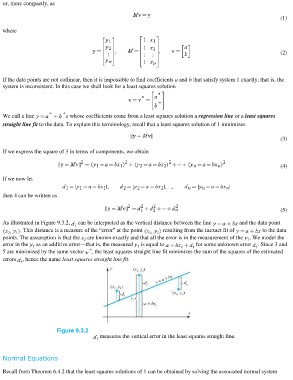
As illustrated in Figure 9.3.2, can be interpreted as the vertical distance between the line        and the data point

. This distance is a measure of the “error” at the point         resulting from the inexact fit of               to the data

points. The assumption is that the are known exactly and that all the error is in the measurement of the . We model the

error in the as an additive error—that is, the measured is equal to  for some unknown error . Since 3 and

5 are minimized by the same vector , the least squares straight line fit minimizes the sum of the squares of the estimated

errors , hence the name least squares straight line fit.

                            Figure 9.3.2
                                                   measures the vertical error in the least squares straight line.

Normal Equations

Recall from Theorem 6.4.2 that the least squares solutions of 1 can be obtained by solving the associated normal system

