


Page 688 - Elementary_Linear_Algebra_with_Applications_Anton__9_edition
P. 688
Find the matrix for a shear in the x-direction that transforms the triangle with vertices (0, 0), (2, 1), and (3, 0) into a right
18. triangle with the right angle at the origin.

19.
         (a) Show that multiplication by

maps every point in the plane onto the line                          .

(b) It follows from part (a) that the noncollinear points (1, 0), (0, 1), (−1, 0) are mapped on a line. Does this violate part (e)
     of Theorem 2?

     Prove part (a) of Theorem 2.
20.

Hint A line in the plane has an equation of the form                    , where A and B are not both zero. Use the method of

Example 8 to show that the image of this line under multiplication by the invertible matrix

has the equation                   , where

     Then show that and are not both zero to conclude that the image is a line.

     Use the hint in Exercise 20 to prove parts (b) and (c) of Theorem 2.
21.

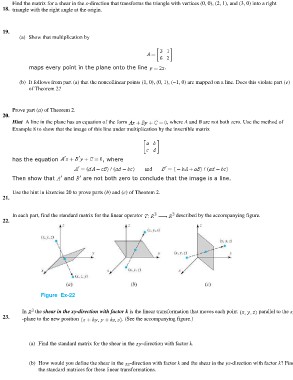
     In each part, find the standard matrix for the linear operator     described by the accompanying figure.
22.

Figure Ex-22

In the shear in the xy-direction with factor k is the linear transformation that moves each point  parallel to the

23. -plane to the new position     . (See the accompanying figure.)

(a) Find the standard matrix for the shear in the -direction with factor k.

(b) How would you define the shear in the -direction with factor k and the shear in the -direction with factor k? Find
     the standard matrices for these linear transformations.

