


Page 733 - Elementary_Linear_Algebra_with_Applications_Anton__9_edition
P. 733
9.7               In this section we shall apply the diagonalization techniques developed in
                  the preceding section to quadratic equations in three variables, and we
QUADRIC SURFACES  shall use our results to study quadric surfaces.

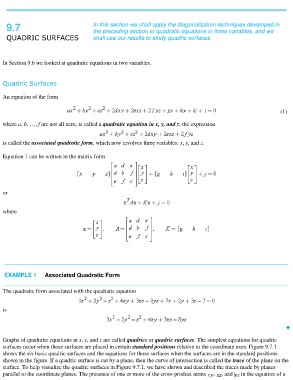
In Section 9.6 we looked at quadratic equations in two variables.                                 (1)

Quadric Surfaces

An equation of the form

where a, b, …, f are not all zero, is called a quadratic equation in x, y, and z; the expression
is called the associated quadratic form, which now involves three variables: x, y, and z.
Equation 1 can be written in the matrix form

or
where

EXAMPLE 1 Associated Quadratic Form

The quadratic form associated with the quadratic equation

is

Graphs of quadratic equations in x, y, and z are called quadrics or quadric surfaces. The simplest equations for quadric
surfaces occur when those surfaces are placed in certain standard positions relative to the coordinate axes. Figure 9.7.1
shows the six basic quadric surfaces and the equations for those surfaces when the surfaces are in the standard positions
shown in the figure. If a quadric surface is cut by a plane, then the curve of intersection is called the trace of the plane on the
surface. To help visualize the quadric surfaces in Figure 9.7.1, we have shown and described the traces made by planes
parallel to the coordinate planes. The presence of one or more of the cross-product terms , , and in the equation of a

