


Page 755 - Elementary_Linear_Algebra_with_Applications_Anton__9_edition
P. 755
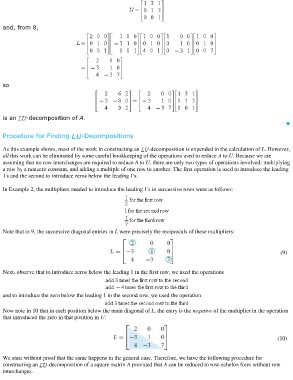
and, from 8,

so

is an -decomposition of A.

Procedure for Finding -Decompositions

As this example shows, most of the work in constructing an -decomposition is expended in the calculation of L. However,
all this work can be eliminated by some careful bookkeeping of the operations used to reduce A to U. Because we are
assuming that no row interchanges are required to reduce A to U, there are only two types of operations involved: multiplying
a row by a nonzero constant, and adding a multiple of one row to another. The first operation is used to introduce the leading
1's and the second to introduce zeros below the leading 1's.
In Example 2, the multipliers needed to introduce the leading 1's in successive rows were as follows:

Note that in 9, the successive diagonal entries in L were precisely the reciprocals of these multipliers:  (9)
Next, observe that to introduce zeros below the leading 1 in the first row, we used the operations

and to introduce the zero below the leading 1 in the second row, we used the operation

Now note in 10 that in each position below the main diagonal of L, the entry is the negative of the multiplier in the operation
that introduced the zero in that position in U:

                                                                                                                                                  (10)

We state without proof that the same happens in the general case. Therefore, we have the following procedure for
constructing an -decomposition of a square matrix A provided that A can be reduced to row-echelon form without row
interchanges.

