


Page 757 - Elementary_Linear_Algebra_with_Applications_Anton__9_edition
P. 757
-decomposition.

We conclude this section by briefly discussing two fundamental questions about -decompositions:
   1. Does every square matrix have an -decomposition?
   2. Can a square matrix have more than one -decomposition?

We already know that if a square matrix A can be reduced to row-echelon form by Gaussian elimination without row
interchanges, then A has an -decomposition. In general, if row interchanges are required to reduce matrix A to
row-echelon form, then there is no -decomposition of A. However, in such cases it is possible to factor A in the form of a

      -decomposition
where L is lower triangular, U is upper triangular, and P is a matrix obtained by interchanging the rows of appropriately
(see Exercise 17). Any matrix that is equal to the identity matrix with the order of its rows changed is called a permutation
matrix.
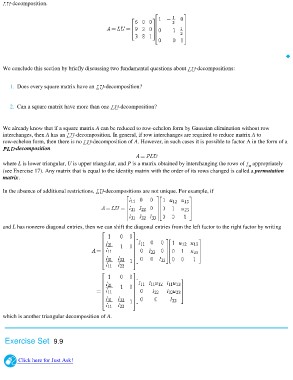
In the absence of additional restrictions, -decompositions are not unique. For example, if

and L has nonzero diagonal entries, then we can shift the diagonal entries from the left factor to the right factor by writing

which is another triangular decomposition of A.

Exercise Set 9.9

        Click here for Just Ask!

