


Page 764 - Elementary_Linear_Algebra_with_Applications_Anton__9_edition
P. 764
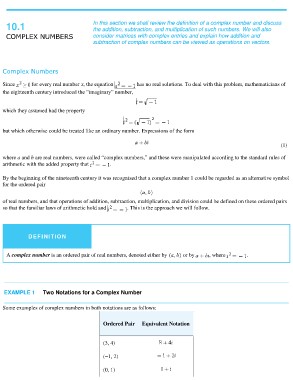
10.1                                     In this section we shall review the definition of a complex number and discuss
                                         the addition, subtraction, and multiplication of such numbers. We will also
COMPLEX NUMBERS                          consider matrices with complex entries and explain how addition and
                                         subtraction of complex numbers can be viewed as operations on vectors.

Complex Numbers

Since  for every real number x, the equation               has no real solutions. To deal with this problem, mathematicians of

the eighteenth century introduced the “imaginary” number,

which they assumed had the property

but which otherwise could be treated like an ordinary number. Expressions of the form

                                                                                                     (1)

where a and b are real numbers, were called “complex numbers,” and these were manipulated according to the standard rules of

arithmetic with the added property that           .

By the beginning of the nineteenth century it was recognized that a complex number 1 could be regarded as an alternative symbol
for the ordered pair

of real numbers, and that operations of addition, subtraction, multiplication, and division could be defined on these ordered pairs

so that the familiar laws of arithmetic hold and     . This is the approach we will follow.

            DEFINITION                                                  or by            , where  .
A complex number is an ordered pair of real numbers, denoted either by

EXAMPLE 1 Two Notations for a Complex Number
Some examples of complex numbers in both notations are as follows:

                                                       Ordered Pair Equivalent Notation

                                                       (3, 4)
                                                       (−1, 2)
                                                       (0, 1)

