


Page 766 - Elementary_Linear_Algebra_with_Applications_Anton__9_edition
P. 766
The Complex Plane

Sometimes it is convenient to use a single letter, such as z, to denote a complex number. Thus we might write

The real number a is called the real part of z, and the real number b is called the imaginary part of z. These numbers are denoted
by and , respectively. Thus

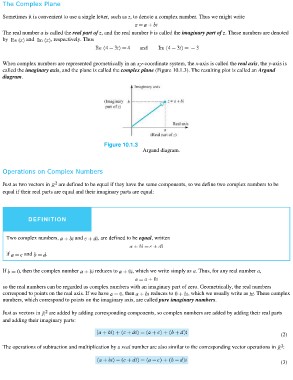
When complex numbers are represented geometrically in an -coordinate system, the x-axis is called the real axis, the y-axis is
called the imaginary axis, and the plane is called the complex plane (Figure 10.1.3). The resulting plot is called an Argand
diagram.

                                                       Figure 10.1.3
                                                                            Argand diagram.

Operations on Complex Numbers

Just as two vectors in are defined to be equal if they have the same components, so we define two complex numbers to be
equal if their real parts are equal and their imaginary parts are equal:

DEFINITION

Two complex numbers,  and , are defined to be equal, written

if and .

If , then the complex number  reduces to  , which we write simply as a. Thus, for any real number a,

so the real numbers can be regarded as complex numbers with an imaginary part of zero. Geometrically, the real numbers

correspond to points on the real axis. If we have , then  reduces to  , which we usually write as . These complex

numbers, which correspond to points on the imaginary axis, are called pure imaginary numbers.

Just as vectors in are added by adding corresponding components, so complex numbers are added by adding their real parts
and adding their imaginary parts:

                                                                                                                                                        (2)
The operations of subtraction and multiplication by a real number are also similar to the corresponding vector operations in :

                                                                                                                         (3)

