


Page 852 - Elementary_Linear_Algebra_with_Applications_Anton__9_edition
P. 852
EXAMPLE 1 Finding Currents in a Circuit
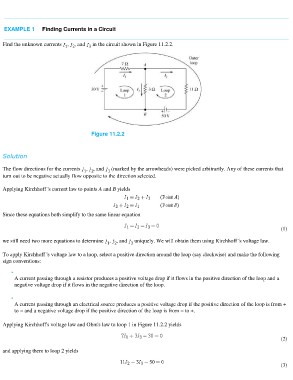
Find the unknown currents , , and in the circuit shown in Figure 11.2.2.

                                                 Figure 11.2.2

Solution

The flow directions for the currents , , and (marked by the arrowheads) were picked arbitrarily. Any of these currents that
turn out to be negative actually flow opposite to the direction selected.
Applying Kirchhoff 's current law to points A and B yields

Since these equations both simplify to the same linear equation

                                                                                                                                 (1)

we still need two more equations to determine , , and uniquely. We will obtain them using Kirchhoff 's voltage law.

To apply Kirchhoff 's voltage law to a loop, select a positive direction around the loop (say clockwise) and make the following
sign conventions:

A current passing through a resistor produces a positive voltage drop if it flows in the positive direction of the loop and a
negative voltage drop if it flows in the negative direction of the loop.

A current passing through an electrical source produces a positive voltage drop if the positive direction of the loop is from +
to − and a negative voltage drop if the positive direction of the loop is from − to +.

Applying Kirchhoff's voltage law and Ohm's law to loop 1 in Figure 11.2.2 yields

                                                                                                                                 (2)

and applying them to loop 2 yields

                                                                                                                                 (3)

