


Page 881 - Elementary_Linear_Algebra_with_Applications_Anton__9_edition
P. 881
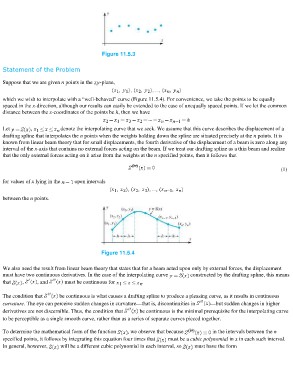
Figure 11.5.3

Statement of the Problem

Suppose that we are given n points in the -plane,

which we wish to interpolate with a “well-behaved” curve (Figure 11.5.4). For convenience, we take the points to be equally
spaced in the x-direction, although our results can easily be extended to the case of unequally spaced points. If we let the common
distance between the x-coordinates of the points be h, then we have

Let ,                         denote the interpolating curve that we seek. We assume that this curve describes the displacement of a

drafting spline that interpolates the n points when the weights holding down the spline are situated precisely at the n points. It is

known from linear beam theory that for small displacements, the fourth derivative of the displacement of a beam is zero along any

interval of the x-axis that contains no external forces acting on the beam. If we treat our drafting spline as a thin beam and realize

that the only external forces acting on it arise from the weights at the n specified points, then it follows that

                                                                                                                                (1)

for values of x lying in the  open intervals

between the n points.

                              Figure 11.5.4

We also need the result from linear beam theory that states that for a beam acted upon only by external forces, the displacement

must have two continuous derivatives. In the case of the interpolating curve  constructed by the drafting spline, this means

that , , and                  must be continuous for                  .

The condition that     be continuous is what causes a drafting spline to produce a pleasing curve, as it results in continuous

curvature. The eye can perceive sudden changes in curvature—that is, discontinuities in  —but sudden changes in higher

derivatives are not discernible. Thus, the condition that             be continuous is the minimal prerequisite for the interpolating curve

to be perceptible as a single smooth curve, rather than as a series of separate curves pieced together.

To determine the mathematical form of the function , we observe that because             in the intervals between the n

specified points, it follows by integrating this equation four times that must be a cubic polynomial in x in each such interval.

In general, however, will be a different cubic polynomial in each interval, so must have the form

