


Page 886 - Elementary_Linear_Algebra_with_Applications_Anton__9_edition
P. 886
the endpoints and and resulting in the mathematical conditions                     .

The natural spline tends to flatten the interpolating curve at the endpoints, which may be undesirable. Of course, if it is required
that vanish at the endpoints, then the natural spline must be used.

The Parabolic Runout Spline

The two additional constraints imposed for this type of spline are

                                                                                                                 (19)

                                                                                                                 (20)

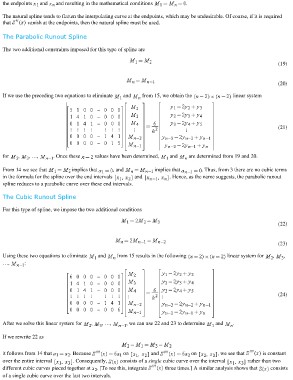
If we use the preceding two equations to eliminate and from 15, we obtain the                 linear system

                                                                                                                 (21)

for , , …,                . Once these  values have been determined, and are determined from 19 and 20.

From 14 we see that       implies that                , and          implies that         . Thus, from 3 there are no cubic terms

in the formula for the spline over the end intervals           and   . Hence, as the name suggests, the parabolic runout

spline reduces to a parabolic curve over these end intervals.

The Cubic Runout Spline

For this type of spline, we impose the two additional conditions

                                                                                                                 (22)

Using these two equations to eliminate and from 15 results in the following                   linear system for    (23)
…, :                                                                                                             ,,

                                                                                                                 (24)

After we solve this linear system for , , …,                 , we can use 22 and 23 to determine and .
If we rewrite 22 as

it follows from 14 that   . Because                   on and                          on  , we see that      is constant

over the entire interval  . Consequently, consists of a single cubic curve over the interval             rather than two

different cubic curves pieced together at . [To see this, integrate  three times.] A similar analysis shows that consists

of a single cubic curve over the last two intervals.

