


Page 94 - Elementary_Linear_Algebra_with_Applications_Anton__9_edition
P. 94
Prove that if A is an invertible matrix and B is row equivalent to A, then B is also invertible.
18.

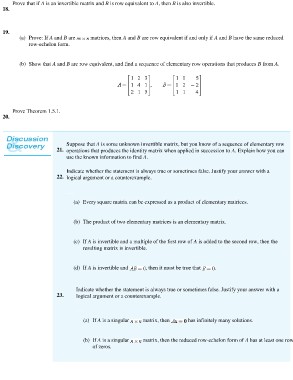
19.                                 matrices, then A and B are row equivalent if and only if A and B have the same reduced
         (a) Prove: If A and B are

              row-echelon form.

(b) Show that A and B are row equivalent, and find a sequence of elementary row operations that produces B from A.

     Prove Theorem 1.5.1.
20.

     Suppose that A is some unknown invertible matrix, but you know of a sequence of elementary row
21. operations that produces the identity matrix when applied in succession to A. Explain how you can

     use the known information to find A.

     Indicate whether the statement is always true or sometimes false. Justify your answer with a
22. logical argument or a counterexample.

                           (a) Every square matrix can be expressed as a product of elementary matrices.

                           (b) The product of two elementary matrices is an elementary matrix.

                           (c) If A is invertible and a multiple of the first row of A is added to the second row, then the
                                resulting matrix is invertible.

                           (d) If A is invertible and       , then it must be true that .

          Indicate whether the statement is always true or sometimes false. Justify your answer with a
23. logical argument or a counterexample.

                                    (a) If A is a singular matrix, then  has infinitely many solutions.

                                    (b) If A is a singular  matrix, then the reduced row-echelon form of A has at least one row
                                         of zeros.

