


Page 11 - Lecture Notes DCC3113
P. 11
Constructional features of a Roman Road
i. They weary very thick. Total thickness of the road varied from about 0.7 m to as much as 1.2 m.
ii. They were straight, without any regard for gradient. Probable reason for straightness may be
their main use for army.
iii. Roads were not built on soft soil formations but on hard stratum reached after excavation.
Modern roads
In eighteenth century, improved construction methods for roads again began to develop. Mr.
Pierre Tresaquet developed an improved method of construction in 1764 in France. At the time when
Mr. Pierre Tresaquet was busy in developing his road construction method, Mr. John Metcalf was
engaged in his development in England. Metcalf constructed about 290 Km road in northern region of
England. Since Metcalf was blind, his work was not recorded and thus got lost. Telford and Macadam
were the pioneers in road development in England. Telford believed in using heavy foundation stones
over the soil sub-grade, while Macadam advocated the use of compacted crushed aggregate layer at the
bottom. Macadam’s method of road construction is still in used and is named after his name.
Type of road pavements
Laterite/Dirt Road
Use original soil or compacted embankment as surface. Normally constructed in rural area and typical
soil is laterite
Soil subgrade
Figure 1-9: Dirt Road
Gravel Road
Layer of aggregate spread on compacted soil forming stronger road
Figure 1-10: Gravel Road
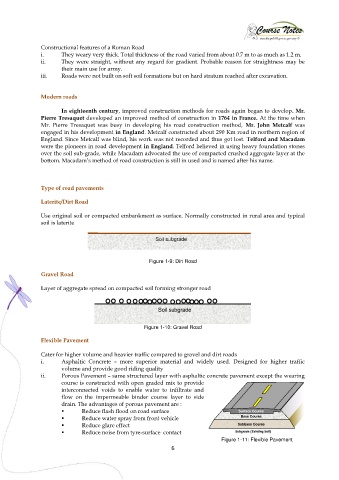
Flexible Pavement
Cater for higher volume and heavier traffic compared to gravel and dirt roads
i. Asphaltic Concrete – more superior material and widely used. Designed for higher traffic
volume and provide good riding quality
ii. Porous Pavement – same structured layer with asphaltic concrete pavement except the wearing
course is constructed with open graded mix to provide
interconnected voids to enable water to infiltrate and
flow on the impermeable binder course layer to side
drain. The advantages of porous pavement are :
Reduce flash flood on road surface Surface Course
Reduce water spray from front vehicle Base Course
Reduce glare effect Subbase Course
Reduce noise from tyre-surface contact
Figure 1-11: Flexible Pavement
6

