


Page 88 - Lecture Notes DCC3113
P. 88
6.2 THE TYPES OF ROAD FURNITURE IN HIGHWAY ENGINEERING
6.2.1 The objectives of road signs
To regulate traffic or to warn or guide road users.
6.2.2 The basic principles of:
a. Road signs
Should be uniform in design, position and application so that they may be recognised and
understood immediately by all road users.
No longer applicable which may create confusion in the mind of the motorist shall be removed
or obliterated as soon as practicable. Other markings and delineations required by road
conditions or restrictions should be remove or obliterated when those conditions cease to exist
or the restrictions are withdrawn.
Must be visible at night shall be reflectorised unless ambient allumination assures adequate
visibility. All markings on highways shall be reflectorised. Even on well lighted town and streets
it is generally desirable markings which must be visible at night be reflectorised.
In addition to reflectorised lines the use of road studs may be considered for roads with poor
alignment or at dangerous situations, for eg. at important junctions and intersections.
Road markings have definite limitations. They may not be clearly visible when wet, and may not
be very durable when subjected to heavy traffic. Therefore they require frequent maintenance.
Their effect on skid resistance requires care in the choice of materials to be used. Finally they
cannot be applied to unsealed roads.
b. Traffic signboards
The FOUR (4) basic principles of traffic signboard
i. Colour
ii. Shape
iii. Size, Wording, and symbol
iv. Material
6.2.3 The color of material, types and specification of:
a. Road studs
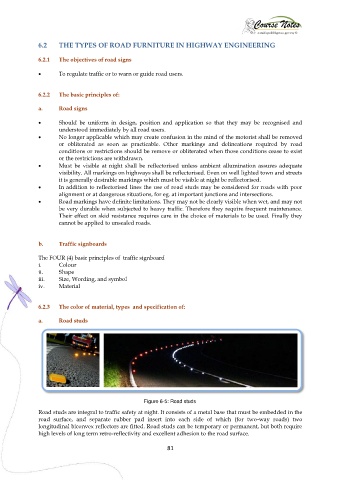
Figure 6-5: Road studs
Road studs are integral to traffic safety at night. It consists of a metal base that must be embedded in the
road surface, and separate rubber pad insert into each side of which (for two-way roads) two
longitudinal biconvex reflectors are fitted. Road studs can be temporary or permanent, but both require
high levels of long term retro-reflectivity and excellent adhesion to the road surface.
81

