


Page 89 - Lecture Notes DCC3113
P. 89
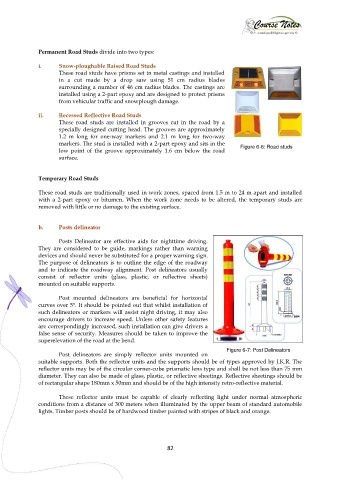
Permanent Road Studs divide into two types:

               i.     Snow-ploughable Raised Road Studs
                      These road studs have prisms set in metal castings and installed
                      in  a  cut  made  by  a  drop  saw  using  51  cm  radius  blades
                      surrounding a number of 46 cm radius blades. The castings are
                      installed using a 2-part epoxy and are designed to protect prisms
                      from vehicular traffic and snowplough damage.

               ii.    Recessed Reflective Road Studs
                      These  road  studs  are  installed  in  grooves  cut  in  the  road  by  a
                      specially designed cutting head. The grooves are approximately
                      1.2  m  long  for  one-way  markers  and  2.1  m  long  for  two-way
                      markers. The stud is installed with a 2-part epoxy and sits in the   Figure 6-6: Road studs
                      low  point  of  the  groove  approximately  1.6  cm  below  the  road
                      surface.


               Temporary Road Studs

               These road studs are traditionally used in work zones, spaced from 1.5 m to 24 m apart and installed
               with  a  2-part  epoxy  or  bitumen.  When  the  work  zone  needs  to  be  altered,  the  temporary  studs  are
               removed with little or no damage to the existing surface.


               b.     Posts delineator

                      Posts  Delineator  are  effective  aids  for  nighttime  driving.
               They  are  considered  to  be  guide,  markings  rather  than  warning
               devices and should never be substituted for a proper warning sign.
               The purpose of delineators is to outline the edge of the roadway
               and  to  indicate  the  roadway  alignment.  Post  delineators  usually
               consist  of  reflector  units  (glass,  plastic,  or  reflective  sheets)
               mounted on suitable supports.

                      Post  mounted  delineators  are  beneficial  for  horizontal
               curves over 5°. It should be pointed out that whilst installation of
               such delineators or markers will assist night driving, it may also
               encourage  drivers  to  increase  speed.  Unless  other  safety  features
               are correspondingly increased, such installation can give drivers a
               false sense of security. Measures should be taken to improve the
               superelevation of the road at the bend.
                                                                                 Figure 6-7: Post Delineators
                      Post  delineators  are  simply  reflector  units  mounted  on
               suitable supports. Both the reflector units and the supports should be of types approved by J.K.R. The
               reflector units may be of the circular corner-cube prismatic lens type and shall be not less than 75 mm
               diameter. They can also be made of glass, plastic, or reflective sheetings. Reflective sheetings should be
               of rectangular shape 180mm x 50mm and should be of the high intensity retro-reflective material.

                      These  reflector  units  must  be  capable  of  clearly  reflecting  light  under  normal  atmospheric
               conditions from a distance of 300 meters when illuminated by the upper beam of standard automobile
               lights. Timber posts should be of hardwood timber painted with stripes of black and orange.


                                                            82

