


Page 106 - SCIENCE DLP T6 SK (SEMAKAN 2017)
P. 106
Types of Surface


         1.  Aim: __________________________________________________
         2.  Problem statement: How does the surface of an object affect frictional force?
         3.  Hypothesis: ____________________________________________________
         4.  Variables:
             (a) manipulated: ____________________________________________
             (b) responding: _____________________________________________
             (c)  constant: _________________________________________________
         5.  Apparatus and materials: ruler, two books, cardboard, dry cell, paper,
             cloth, sandpaper, small carpet
         6.  Steps:

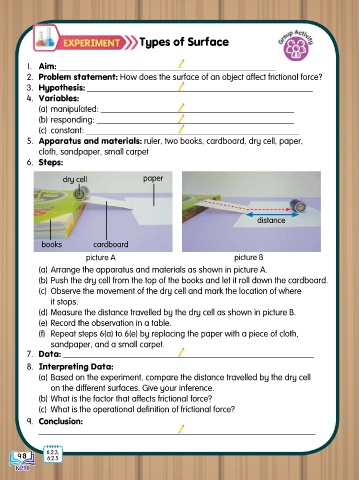
                    dry cell                paper


                                                                              distance


              books          cardboard

                           picture A                                    picture B
             (a) Arrange the apparatus and materials as shown in picture A.
             (b) Push the dry cell from the top of the books and let it roll down the cardboard.
             (c)  Observe the movement of the dry cell and mark the location of where
                it stops.
             (d) Measure the distance travelled by the dry cell as shown in picture B.
             (e) Record the observation in a table.
             (f)  Repeat steps 6(a) to 6(e) by replacing the paper with a piece of cloth,
                sandpaper, and a small carpet.
         7.  Data: _________________________________________________________
         8.  Interpreting Data:
             (a) Based on the experiment, compare the distance travelled by the dry cell
                on the different surfaces. Give your inference.
             (b) What is the factor that affects frictional force?
             (c)  What is the operational definition of frictional force?
         9.  Conclusion:
             ________________________________________________________________


               6.2.3,
      98       6.2.5

