


Page 167 - Career Readiness Catalog
P. 167
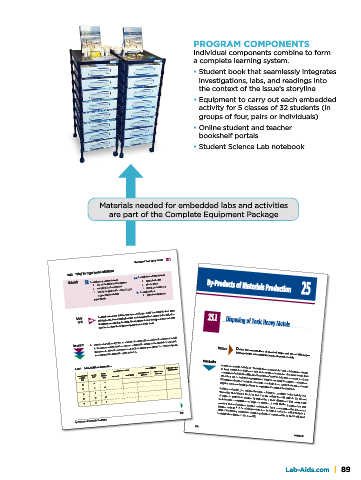
PROGRAM COMPONENTS
                                                               Individual components combine to form
                                                               a complete learning system.

                                                               •  Student book that seamlessly integrates
                                                                investigations, labs, and readings into
                                                                the context of the issue’s storyline
                                                               •  Equipment to carry out each embedded
                                                                activity for 5 classes of 32 students (in
                                                                groups of four, pairs or individuals)

                                                               •  Online student and teacher
                                                                bookshelf portals
                                                               • Student Science Lab notebook


                                 Materials needed for embedded labs and activities
                                    are part of the Complete Equipment Package


                                            Disposing of Toxic Heavy Metals 25.1

                      Part A  “Fixing” the Copper Ions in a Solid Mixture
                                             For each team of two students
                       Materials  For each group of four students  1   clear plastic cup
                                               plastic spoon
                               1   180-mL bottle of sodium silicate  1   30-mL graduated cup  By-Products of Materials Production  25
                                sample of Portland cement
                               1   120-mL dropper bottle of 50,000 ppm   1
                               1              For each student
                                copper sulfate solution  1   pair of safety glasses
                               paper towels
                                Portland cement can irritate your eyes and lungs. Avoid breathing its dust. Wear   25.1
                         Safety   safety glasses. Do not wash glassware containing Portland cement in the sink, since
                          Note  it will permanently clog the drain. Use wet paper towels to wipe out cups and clean   Disposing of Toxic Heavy Metals
                                your hands. Then throw the used paper towels in the trash.
                              1.  Your teacher will assign you an amount of sodium silicate and Portland cement to add
                        Procedure  to the copper sulfate solution. Prepare a data table similar to the one below and circle   Purpose
                               the amounts of Portland cement and sodium silicate your group has been assigned.
                               You will use this data table again in Part C.  bearing solution into a solid that can be disposed of safely.
                                                                            Detect low concentrations of dissolved copper and convert this copper-
                                                                  Introduction
                         Table 1  Solid and Filtrate Observations  Color of Filtrate  Estimated Copper
                                     Appearance of Mixture  After Adding  Concentration  or leach, metals from their ores. Rain water or groundwater can also leach metals from
                                                                        As you observed in Activity 24, “Material Resources: Metals,” acid solutions can release,
                                              Acid Rain
                              Cement  Sodium  From Simulated  Ammonia
                         Copper Sulfate  (cm 3 )  Silicate  When Wet  After Drying  contaminated soil and landfills. Small amounts of heavy metals, such as copper, lead, and
                          Solution  (mL)
                           (mL)                                        chromium, can be toxic to living organisms. Water moves easily through the environment.
                                  0                                    If it contains dissolved metals or other toxic chemicals, it can contaminate soil and water
                               20
                           10                                          supplies and cause health problems for organisms throughout the food web.
                               0  20
                           10
                               5  15                                   In this investigation, you will use the waste solution you produced during Activity 24.1,
                           10                                          “Extracting Metal From a Rock.” In Part B of this activity you will estimate the amount
                                  10
                               10
                           10                                          of copper in your waste solution by performing a serial dilution and then using a test
                               15  5                                   to detect low concentrations of copper in solution. A serial dilution is a procedure that
                            10                                         creates a series of solutions in which each solution has a concentration that is an exact
                                                          299         leaching when disposed of in a landfill.
                                                                      fraction, such as  1 ⁄2 or  1 ⁄10, of the previous one. In Parts A and C you will investigate a
                                                                      method for treating wastewater containing dissolved copper sulfate so that it will resist
                         By-Products of Materials Production
                                                               298
                                                                                               Activity 25
                                                                                            Lab-Aids.com  |  89

