


Page 13 - NAVAL SCIENCE 3 TEXTBOOK
P. 13
18      NAVAL KNOWLEDGE


        the last in  1996, that modified some of the provisions of the ear-  overseas represents a vital and steadily growing part of our national
        lier three. The Merchant rvfarine Act of 1936 was described above.   econolllY. Some 90 percent of our domestic <md foreign trade trav-
        Probably the  most significant  of all  of them was  the Jones Act of   els via the sea lanes. There can be no doubt about the importance
        1920. Its purpose as stated  in  the act is  that it is necessary for  the   of waterborne commerce  to  the  prosperity and high standard of
        national defense and proper growth of foreign and domestic COIll-  living of the American people now and in the fuhlre.
        merce that  the United States shall  have a merchant marine of the   The prunaq' commercial purpose  for operating the merchant
        best equipped and most suitable types of vessels sufficient to C<Irq'   fleet  is,  of course,  to  make  a  reasonable  profit.  However,  this  is
        the greater portion of its commerce and serve as a naval auxiliary   much easier said than done. U.S.  shipping companies  often  have
        in  time of war or national emergency.  It specified that all  domes-  to  compete  with  rebates  given by  foreign  manufacturers  to  for-
        tic waterborne COIllmerce between two points in  the United States   eign shipping companies to carry their products at premium rates.
        must be carried by U.S.-owned and -operated vessels. Subsequent   A rebate is a nice  term  for a kickback or bribe, a practice  that  is
        federal  regulations also require that at least half of all  U.S. govern-  illegal under U.S. law, but  an  accepted  way  of doing business  in
        ment cargos be carried by American-flag shipping.      many foreign  countries.  Also,  a poor record  of labor stability  in
                                                               American  maritime unions has periodically tied  up  U.S.-flagged
                                                               ships.  These  factors,  along with  the perennial  problems of rising
        The Impact of Wat erborne Commerce                     taxes and insurance costs and higher shipbuilding and labor costs

        Throughout the globe. the preferred method of transporting large   over the years, have caused the percentage of American cargo car-
        quantities of raw  materials and  manufactured  trade  goods  is  by   ried in American ships to drop to less than 3 percent of the current
        water, because this is the fastest, most efficient, and least costly way.   annual total. There are just over 400 commercial oceangoing ships
        Some 80 percent of all world trade goods tr<wel by water. The other   of more than  1,000  gross tons  in  the  U.S.-flag fleet--of an  esti-
        transport  systems-rail.  truck,  aircraft,  and  pipeline-support,   mated tot<ll  of some 29,000 in service worldwide.
        augment, and complement waterborne transport.             In  the  United  States  there  are  some  350  ports  that  handle
           As  mentioned  in  the previous chapter,  the economies  of all   freight, passengers, or both. Over 2 billion tOilS of cargo and  150
        nations  of the  world  ha\'e  become  interdependent  to  a  degree   million  passengers pass  through  these ports each year. Currently,
        never  before seen  in  the  history of the  world.  No  nation has <lll   the ten leading U.S. marine ports, in the order of the value of ship-
        the resources it needs to be completely independent, nor can any   ments handled, are the ports of Los Angles, California; New York!
        nation's economy thrive  without marketing its goods be}'ond  its   New Jersey;  Long lkach, California; Houston, 'texas; Charleston,
        borders.  The United  States,  for  example,  must import o\'er  one   South Carolina; Norfolk, Virginia; Tacoma. \,Vashington; Baltimore,
        hundred vital metals and minerals from more than sixty countries,   Mar)lland; Oakland, California; and Seattle. \'Vashington.
        including almost  70 percent of our petroleum, nearly 100 percent   Because  much  of the world's  oceangoing commercial  fleet  is
        of ores such as aluminum ilnd chromium, and a growing percent-  aging at a tairly rapid  pace,  orders  for  new  and  larger  merchant
        age  of fmished steel products. Grain  from  our farms  is marketed   ships of all  descriptions  are  increasing  at  building  yards  world-
        worldwide,  and  income  frOIll  our  manufactured  products  sold   wide,  especially  in  Asia, where  Japan  and  South  Korea  together
                                                               account  for  some  70  percent of the world  shipbuilding  market.
                                                               Unfortunately the  United  States does  not get  much  of this busi-
                                                               ness,  bCCi.1USe  of higher  labor  and construction  costs  here.  l\'fost
                                                               of the large shipbuilding ya rds  in  the United  States specialize  in
                                                               the construction of naval  vessels,  although  most also build some
                                                               high  quality  cOlllmercial  \'essels. The  five  largest  U.S.  shipyards
                                                               in  the  United  States  are  Northrop  Grumman/Newport  News,
                                                               Newport News, Virginia; Northrop Grumman/lngalls, Pascagoula,
                                                               i\'{ississippi; General Dynamics/Electric 13oat, Groton, Connecticut;
                                                               General  Dynamks/B<lth  Iron \Vorks.  Bath, Maine;  and Northrop
                                                               Grumman/Avondale, in New Orleans and lallulah, Louisiana, and
                                                               Gulfport, Mississippi.


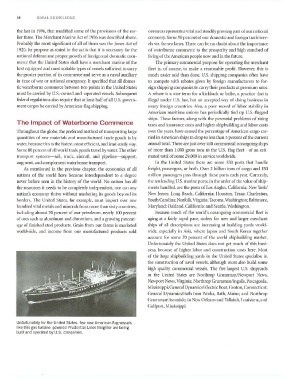
        Unfortunately for the  United States,  few  new American-flag vessels
        like th is gas turbine- powered  Prudential  Lines freighter are  being
        built and  operated  by  U.S.  compan ies.

