


Page 16 - NAVAL SCIENCE 3 TEXTBOOK
P. 16
SEA  POWE It  AN D  NAT I ONA L  SEC UR ITY   21

            Sealift  Readiness  and  VISA  Programs.  Under  the  provisions   backs here, so the reliability of this source ill time of Ilational emer-
         of the  Sealift  Readiness  Program  (SRP), lip  to  half of all  U.S.-  gcnC)l is marginal at best.
         flag  merch,lIlt  ships  may  be  voluntarily  conscripted  for  mili-
         tary usc  in  time of nationnl emergency. Although ill effect since
                                                                Transport of Strategic Material
         1978,  the  SPI(  has  never been  activated  to  date.  The VoluntilfY
         Intermoclal Sealift Agreement (VISA), enacted in  1997, creates a   In  i.ldditioll  to  militar),  cargoes.  the  merchant  marine  must
         partnership betw('cn the U.S. Government nne! the U.S. maritime   carr)'  the  strategic  materials  and  energy  resources  that support
         industr)' to  provide commercial scnlift and  intermodal support   the  national  econom)' and  defense  establishment. Our allies  also
         services required to meet ilny future national mobilization needs.   require such sealift. Britain, for instance. must continually import
         VISA participants get priorit)' preference when bidding on DOD   food  to sustain  its  population, and  Japan  is  totall),  dependent on
         peacetime cargo.                                       imported oiL If the U,S, industrial complex is to support our forces
            Active  Merchant  Fleet  Sealift  Readiness  Program.  The  Sealift   and  those  of our  allies  in  time  of war.  the  movement  of cargo
         Readiness  Progrmn  is designed  to  improve  the  response  of pri-  across the oceans to and from  the United States Illust continue.
         vatc  operators  to  national  defense  needs.  Half of U.S.-flag  mer-  Howe\,er, an  important conccrn  has arisen  in  this area.  from
         chant ships ilrc  designated  under the  program as  being liilblc for   the cOlllmercial standpoint, ill order to maximize efficielK), increas-
         conscription for militM)' scalift duties by the secretaries of dcfcnse   ingl)'  larger  ships  are  needed  to  satisl)'  the  ever-growing indus-
         and transportation in timc of national need. Others are liable to bc   trial demand for bulk strategic materials. particularl), crude oil and
         called on an incrementnl basis, if required.           metallic orcs, Consequently,  fewer but  larger and marc productive
            Effective  U.S.-controlled  ships.  These arc ships owned by U.S.   ships are being built to meet the cOlllmercial requirements. 1.11 a war-
         citizcns or corporations that  are  licensed  by and  fly  the  flags  of   time situation the United States and its allies could ill aftorel to lose
         other nations such  ilS liberia, Panama, and  Honduras in order to   Illany sllch hig commercial ships, for sllch attrition would immedi-
         escape the high insurance ilnd wage costs associated with  U.S. reg-  atel}' have a serious impact on imports of strategic materials,
         istry, Ships in this category ilre said to be operating under "flags of   In time of a national emergency. defensive fcatures would need
         convenience," There  is  somc qucstion  as  to the  responsiveness  of   to be incorporated into our merchant ships,  fortunately, a provi-
         these ships in  all  but the most dire of national  emergencies, and   sion exists that  mandates certain defensive characteristics in  ships
         some doubt as to how valuable the)' would  be in a military sealift   built with government construction subsidies. The additional cost
         capacit)' since most of the ships are bulk cilrriers such as tankers,   of such features is funded by the Department of Commerce on the
         are carriers. ilnd grain  carriers. Also.  most of their crews are for-  basis of Navy recommendations. Among the features  that can be
         eigners who mil)' not support American interests in wartime.   incorporated into ships for better defensc arc  improved compart-
            Foreign-flag ships. A final  possible source of U.S. sealift assets is   mentation, helicopter  pads.  fou ndations  for  self-sustaining con-
         the charter of foreign-flag ships. There are obvious political draw-  tainer cranes, owrhead and ramp adjustments lor I{oRo ships. and


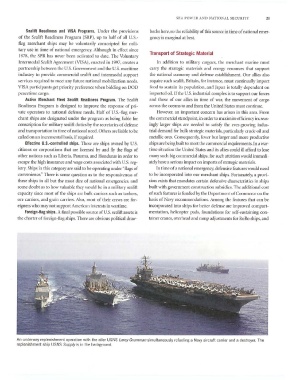
        An underway replenishment operation with the oiler USNS  Leroy Grumman simultaneously refuel ing a Navy aircraft carrier and a destroyer.  The
        replenishment ship USNS  Supply is in the background.

