


Page 14 - NAVAL SCIENCE 3 TEXTBOOK
P. 14
SEA  POWER  AN D  NATIO NA L SECUR ITY   19

          Modern Merchant Ships
          Timkers, ships designed to  GlIT)' liquid cargoes  ill  bulk quantities,
         arc the Illost numerous ships in the active  U.S.  merchant marine
         and arc  the most COlllillo n  type of ship plying the high seas. They
         V'U)' greatly in  size, with the largest modern jumbo tankers rang-
         ing lip  to over a  half million  tons.  Large  tankers arc  used  lll<1iniy
         to carry crude oil  from oil  producing regions to refineries. Smaller
         ones Ciln  carry crude but generill1y carry refined products.  Many
         tankers belong to the major oil  companies, with  their ships carry-
         ing their  OWIl  brand  l1imlC of refined  products.  The majority nre
         owned b)I independent operators who charter their ships.
            Tankers  call  and  do carr)'  other liquid  cargoes  besides  POL
         (petroleum, oils, lubricants), including various chemicals and even
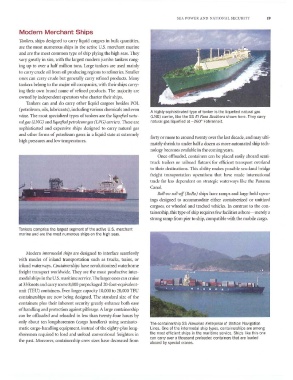
                                                                A highly sophisticated type of tanker is the  liquefied  natural gas
         wine. The Illost specialized types of tankers arc the fiqucjierilllltlf-  (LNG) carrier,  like  the SS  EI Paso Southern shown  here. They carry
                                                                                     0
         ral g(/S (LNG) alld liqllefied peirolelllll gns (I.PG) (mTiers.  These are   natural gas liquefied at  _260 Fahrenheit.
         sophisticated  and  expensive  ships  designed  to  carry natural  gas
         and other forms of petroleum gases in a  liquid state at extremely
                                                                forty or more to around twenty over the last decade, and may ulti-
         high pressures and low temperatures.
                                                                mately shrink to under half a dozen as more automated ship tech-
                                                                nology becomes available in the coming years.
                                                                   Once oftloaded) containers can be placed easily aboard semi-
                                                                truck  trailers  or railroad  natcars  for  efficient  transport  overland
                                                                to  their destinations. This ability makes possible sea-land bridge
                                                                freight  transportation  operations  that  have  made  international
                                                                trade  far  less dependent on str;:llegic  waterwa),s  like  the  Panama
                                                                Canal.
                                                                   Roll-all roll-oh-(lioRo) ships have ramps and  large hold open-
                                                                ings  designed  to  accommodate  either  containerized  or  unitized
                                                                cargoes, or wheeled  and tracked vehicles.  In  contrast to  the  con ~
                                                                tainership, this type of ship requires few facilities ashore-merely it
                                                                strong ramp from pier to ship, compatible with the mobile cargo.

         Tankers comprise the largest segment of the active U.S.  merchant
         marine and are  the  most numerous ships on  the high seas.


            J\llodern inlermocia/ ships are designed to  interface seamlesslr
         with  modes  of inland  transportation  slIch  as  trucks,  tmins,  or
         inland waterways.  Containerships have  revolutionized waterborne
         freight  transport worldwide,  They are the most productive inter-
         modal ships in the U.S. nmritime service. The larger ones can cruise
         at 33 kllots alld calT)' sOllle 8,000 prepackaged20-foot-equivalellt-
         uilit (TEV) colltaillers.  Eveillarger capacity 10,000 to 20,000 TEV
         containerships  are  now being designed.  The standard size of the
         containers plus their inherent security greatly enhance both ease
         of handling ilnd protection against pilferage. A large containership
         can be oflloaded and reloaded in  less  than  twenty-four hours by
         only about  ten  longshoremen  (cargo  handlers)  using  semiauto-
                                                                The  containership SS  Hawaiian  Enterprise of Matson Navigation
         matic cargo-handling equipment, instead of the eighty-plus long-  Lines.  One  of the  intermodal ship types,  containerships are  among
         shoremen required  to  load and unload conventional freighters in   the most efficient ships in  the maritime service.  Ships like this one
                                                                can carry over a thousand  preloaded containers that are loaded
         the past.  Moreover, containership crew sizes  have decreased  from
                                                                aboard  by special cranes,

