


Page 142 - NAVAL SCIENCE 3 TEXTBOOK
P. 142
SII [I'  CONSTR UCT ION  AN D  DA~IAGE CONTROL   147


        electrical  Ilres  but  is ei1ecth'e on  any  small  fire.  Because  COl  is   are lIsed in this type extinguisher. They are often installed in spaces
        heavier than nir. it  lorms a  smothering blanket OYer the fire. CO is   that have materials in them that can be involved in this class offire.
                                                        2
        quick to use and kaves no mess, but Ci.lfbon dioxide "snow" can  be
        blown away by wind or draft. It is not poisonous. but contact with it
                                                               Protective Fire Clothing
        GlJl cause painful skin blisters.
            Dry c/tf!l1Iim/ PKP  extinguishers ilrc milinly for  Class  13  fires.   Anyclothing that covers the skin will protect it from Hash burns <lnd
        The  chemiCi11 used  is  potassium  bicarbonate  (similar  to  baking·   other short-duration flames. Tn addition to their uniforms, person-
        soda). It is called purple-K powder. or PKP. PKP is not poisonous   nel  aboard  Navy ships ilnd shore stations that  may be exposed to
        .. md is four times as effective as CO! for extinguishing fires. The dry   flame and heat in emergency conditions arc isslled flame-retardant
        chemical is an excellent firefighting agent, but its effects are tempo-  hoods and long gloves that arc worn whenever w;'1I"I""1I1ted. Eyes are
         rary.  It has no cooling eftect and  provides no  protection against   protected  with  antitlash  goggles.  If clothing catches  on  fire,  one
         reflash. PKP should be used sparingl)' in confined spaces because it   should  not run, since  this wiII  fan  the names.  Lie down  and  rol1
        will  reduce visibility and make breathing difficult.   up  in  a blanket. coat, or an·),thing that will  smother the flames.  If
            PKP can be lIsed with light W;.lter to produce a highl)1 enectivc   nothing is ;;wailable, the person should roll over slowly, beating out
        extinguishing agent. The dry chemical beats down the fire. and the   the flames with his or her hands.  If another persoll's clothes catch
        light water prevents a reHash.                         0 11  fire. he or she should be put down and covered up (except the
           DI)' powder extinguishers are used  to combat Class  0  fires.  As   head) with a blanket or coat.
         previously mentioned, sodium chloride granules or copper powder


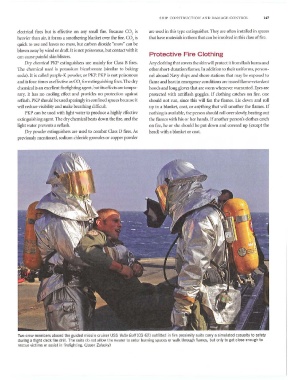
         Two  crew members aboard the guided missile  cru iser  USS  Vella Gulf(CG 62) outfitted  in fire  proximity suits carry a simulated  casualty to safety
         during a flight deck fire drill. The suits do not al low  the wearer  to enter burning spaces or walk through flames,  but only to get close enough to
         rescue victims or assist in  firefighting.  (Jason Zalasky)

