


Page 139 - NAVAL SCIENCE 3 TEXTBOOK
P. 139
144     NAVAL SKILLS


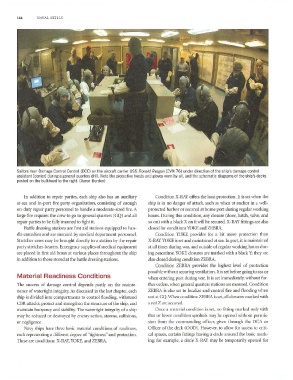
        Sailors man  Damage Control  Central  (DCC)  on  the aircraft carrier USS  Ronald Reagan (CVN  76) under direction of the ship's damage control
        assistant (center) during a general quarters drill.  Note the  protective hoods and gloves worn  by all, and  the schematic diagrams of the ship's decks
        posted on  the  bulkhead  to the right.  (Aaron  Burden)


           In  addition  to  repair  parties,  each  ship  also  has  an  auxiliary   Condition X-RAY ofters the least protcction.It is set when  the
        at-sea  and  in-port fire  party organization, consisting of enough   ship  is  in  no  danger of attack, such as  when  at anchor in  <l  well-
        on-duty repair party personnel to handle a moderate-sized fire. A   protected harbor or secured at home port during regular working
        large fire  requires the crew to  go  to general quarters (GQ) and aU   hours. During this condition, any closure (door, hatch, valve, and
        repair parties to be fully manned to fight il.         so on) with a black X on it will be secured. X-RAY fittings are also
           Battle dressing stations are first  aid stations equipped to  han-  closed for conditions YOKE and ZEBRA.
        dle casualties and  are  manned  by medicli department personnel.   Condition  YOKE  provides  for  a  bit  more  protection  than
        Stretcher cases may be brought directly to a station by the repair   X-RAY. YOKE is set and maintained at sea. In port, it is maintained
        party stretcher-bearers. Emergency supplies of medical equipment   at all  times during war, and outside of regular working hours dur-
        are placed in first aid  boxes at various places throughout the ship   ing peacetime. YOKE closures are marked with a black Y;  they are
        in addition to those stored at the battle dressing stations.   also closed during condition ZEBRA.
                                                                  Condition  ZEBRA  provides  the  highest  level  of protection
                                                               possible without securing ventilation. It is set before going to sea or
        Material Readiness Conditions                          when cntering port during W,lr.  It is set il1lmediately, without fur-

        The  success  of damage  control  depends  partly  on  the  maintc-  ther orders, when general quarters stations are manned. Condition
        nance of watertight integrity. As discllssed in the last chapter, each   ZEBRA  is also  set to  localize and control firc  and  flooding when
        ship is divided  into compartments to control noDding, withstand   not at C;Q. \Vhen condition ZEBRA is set, illl closurcs marked with
        CBR attacks, protcct and strengthen the structure of the ship, and   a red Z are secured.
        maintain buoyancy and stability. The watertight integrity of a ship   Once a material condition is set, no fitting marked  only with
        may be reduced or destroyed by enemy action, storms, collisions,   that or lower condition symbols may be opened without pcrmis-
        or ncgligcnce.                                         sian  from  the  cOlllmanding  officer,  givcn  through  the  DCA  or
           NJ\')' ships  have  three basic  material  conditions of readiness,   Officer of the deck  (OOD). However,  to  allow for  access  to  criti-
        each representing a different degree of "tightness" and protection.   Cill  Sp,lCCS, ccrtain  fittings  baving a circle around the basic mark-
        These are conditions: X-RAY, YOKE, and ZEBRA.          ing;  (or ex,lmple, a circle  X-RAY  may be temporarily opened  for

