


Page 143 - NAVAL SCIENCE 3 TEXTBOOK
P. 143
148     NAVAL  SK ILLS


            The proxilllity firefightillg  s/lit (close-in  suit) consists  of cov-  As  soon  as  the  extent of the fire  is determined, a full  report
         eralls, gloves,  helmet, and boots.  Its helmet provides a protective   is made to  damage control  central.  Upgraded  material  readiness
         cover  for  the  o','gen  breathing  apparatus  (OBA  or SeRA)  that   conditions are set around the entire area.
         is normally worn with  it.  It is lightweight and resists penetration   \·Vhile the firefighting is under way, the team sets up fire bOll1ld-
         of liquids.  The suit allows crew  members to enter overheated or   aries to isolate the fire and keep it from spreading. Fire boundaries
         steam-filled  compartments and  to  make  crash  fire  rescues.  The   arc set in  sevcral ways.  Combustible materials in adjoining spaces
         wearer  is  not expected  to  enter burning spaces  or walk  through   are mo\'ed or cooled to prevent spread of fire by heat transmission.
         flames, only to get close enough to rescue victims or assist  in  put-  Since  fire  can  blister and  ignite  paint on bulkheads in adjoining
         ting the fire out.                                     compartments, fog  or sprinklers are  lIsed  to cool the bulkheads,
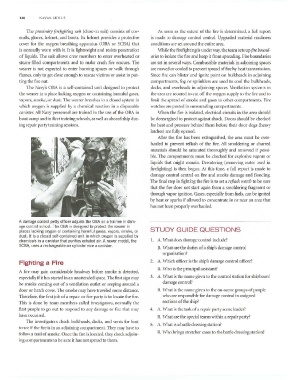
            The Navy's OUA  is a self-contained  unit designed  to  protect   decks,  and overheads in  adjoini ng spaces.  Ventilation  systems  in
         the wearer in  a place lacking oxygen or containing harmful gases,   the area are secured to cut oft'the oxygen supply to the fire and to
         vapors, smoke, or dust.  The wearer breathes in a closed system  in   limit the spread of smoke and gases  to  other compartments. Fire
         which  oxygen  is supplied  by  a chemical reaction  in  a disposable   watches are posted in surrounding compartments.
         canister. All  Navy personnel are  trained  in  the use of the OBA  in   \Vhen  the fire  is  isolated, electrical circuits in  thc area should
         boot camp and ill fleet training schools, as well as aboard ship dur-  be deenergized to protect against shock. Doors should be checked
         ing repair party training sessions.                    for  heat and pressure behind them before their door dogs (heav),
                                                                latches) are full), opened.
                                                                   After  the fire  has been  extinguished,  the area  must be over-
                                                                hauled  to  prevent  reflash  of the  fire.  All  smoldering  or· charred
                                                                materials  should  be saturated  thoroughly and  removed  if possi-
                                                                ble. The compartments must  be checked  for explosive  vapors or
                                                                liquids  that  might  remain.  Dewatering (removing water  used  in
                                                                fire fighting) is  then  begun. At  this  time, a full  report is  made to
                                                                damage control central on fire  and smoke damage and flooding.
                                                                The final step in fighting the fire  is to set a rej7ash  watch to be sure
                                                                that the fire  does  not start again  from  a smoldering fragment or
                                                                through vapor ignition. Gases, especially from fuels, can be ignited
                                                                by heat or sparks if allowed to concentrate in or ncar an area that
                                                                has not been properly ovcrhauled.


         A damage control  petty officer adjusts the OBA on  a trainee  in dam-
         age control  school. The DBA is designed  to protect the wearer in
         places  lacking oxygen  or containing harmful gases, vapors, smoke,  or   STU DY GU IDE Q U ESTIO NS
         dust.  It is a closed  self-contained  unit in  which oxygen  is supplied  by
         chemicals in a canister that purifies exhaled air.  A newer model,  the   1.  A.  \Vhat does damage control include?
         SCBA,  uses a rechargeable air cylinder vice a canister.
                                                                   13.  \·Vhat are the duties of a ship's damage control
                                                                     organization?
         Fight ing a  Fire                                      2.  A.  \Vhich officer is the ship's damage control officer?
                                                                   B.  \·Vho is the principal assistant?
         A fire  may gain  considerable  headway before  smoke  is detected,
         especially if it has started in an unattended space. The first sign may   3.  A.  \Vhat is the name given to the control station lor shipboard
         be smoke coming out of a ventilation outlet or seeping around a   damage control?
         door or hatch cover. The smoke may have traveled some distance.   B.  \·Vhat is the name given to the on-scene groups of people
         Therefore, the first job of a repair or fire  party is  to  locate the fire.   who are responsible for damage control in assigned
         This is  done by team  members called  illI'estigators,  normally the   sections of the ship?
         first people to  go  out to  respond  to  any damage or fire  that  may   4.  A.  \Vhat is the task of a repair part)' scene lcader?
         have occurred.                                            B.  \Vhat are the special teams within a repair party?
            The  investigators check bulkheads, decks, and vents  for  heat
                                                                5.  A.  \'''hat is a battle dressing station?
         to see if the fire is in an adjoining compartment. They may have to
                                                                   B.  \·Vho brings stretcher cases to the battle dressing station?
         follow a trail of smoke. Once the fire  is located, they check adjoin-
         ing compartments to be sure it has not spread to them.

