


Page 155 - NAVAL SCIENCE 3 TEXTBOOK
P. 155
SHIPBOARD O]{GANIZATION AND WATCH STA N ])[NG   161

         the helm and lee helm are in the same console, and both are oper-  over the helm in the evellt of a casualty to the bridge. He or she has
         ated by the same watchstander.                         direct control of the steering gear.  Usually the 000 directs actual
            Messenger.  The  messenger  stands  watch  on  the  bridge  and   shift of steering control to the after station several times each da),.
         delivers messages, answers telephones, ,1I1d carries out other duties   This guarantees that all gear is working correctly and keeps watch-
         assigned by the OOD.                                   standers alert.
            Bridge  sound-powered  telephone  talkers.  A number of bridge
         sound-powered telephone circuits must always be operating when   In-Port Watches
         the  ship  is  under way.  Talkers  relay  messages  O\'el'  these  circuits
                                                                   The  in-port  shipboard  watch  is  similar  in  some  WilyS  to  the
         between the OOD and all stations on the circuit. It  is ver), impor-
                                                                underway watch,  but  there  are  important differences.  In  the  first
         tant that all stations "get the word" about all important events tak-
                                                                place,  the  primilr)' watch station  is  shifted  from  the  bridge  to  the
         ing place during the watch.
                                                                quarterdeck.  The qUilrterdeck  is  located  on  the  main  deck  of the
            lookouts.  Lookouts  stationed  on  the  ship's  superstructure
                                                                ship, uSllaU}' at the head of the brow (access) through which persons
         report aircraft  sightings  and  all  surface  sightings of ships,  craft,
                                                                bo,mi or leave the ship. The OOD stands watch on the quarterdeck.
         obstructions. and so on. They report on the condition of the ship's
                                                                   Another major difference between watches in  port and lInder
         navigational  lights  every  half-hour at  night. The after  lookout  is
                                                                way  is  that  because  much of the ship's  equipment  is  shut down
         stationed on the lim tail with a lifebuoy close at hand in the event of
                                                                (secured) while the ship is in port, not as  lllallY duties and watch-
         a man overboard. Additional lookouts may be posted during peri-
                                                               standel's are required. The ship's company is therefore divided into
         ods of fog  or low visibility.  Each  lookout will  have a sound-pow-
                                                               several rotating ill-port nlft)' sectiollS, normally three while deployed
         ered telephone set to relay all sightings to the bridge.
                                                               overseas, and from four to six while in  U.S. ports and naval bases.
            lifeboat  watch.  Lifeboat  watches  enilble  fast  recovery  of allY
                                                                Each  person in a duty section  must  remain on board throughout
         person  ill  the  wilter.  Ships  conducting  air  operations,  on  plane
                                                               the twenty-four-hour period  his  or her section is  on duty. Those
         guard detail behind <1n  aircraft carrier, or engaged in  other poten-
                                                               personnel  not in  that day's duty section are  free  to  go on  liberty
         tially hazardous operations like underway replenishment, Illuster il
                                                               .lfter working  hours and on weekends.  Each  day's  watchstanders
         reild)' lifeboat crew for each watch, so the ship can launch a lifeboat
                                                               are drawn from that day's duty section.
         on short notice. The watch llsually does not have to remain on the
                                                                  The enlisted  in  port  deck  watch  section  is  gel1emlly  headed
         lifeboat station. But it must be on call, lip and awake and ready for
                                                               b)' the  pett), officer of the watch  (Pom·V).  This is  a senior petty
         fast .lCtion.
                                                               officer qualified  to lead  the enlisted watch. The rest of the watch
            Quartermasler  of  Ihe  watch  (QMOW).  The  QMOW  maintains
                                                               section consists of the brow watch, security watches and patrols,
         the Qllartermaster's Notebook,  which  records among other things
                                                               messenger, duty 1\'[I\I\S, and side boys as required. These will all be
         all orders to the helm or lee helm, and assists the 000 in  naviga-
                                                               described below.
         tional matters. The QJ'dO\·\, is a qualified helmsman.
                                                                  Petty officer of the watch (POOW). The POOW is the OOD's pri-
            After  steering. This watch  is  stationed in  an  emergency steer-
                                                               mary enlisted assistant in-port. He or she supervises and instructs
         ing station in the after part of the ship. This person is able to take
                                                               sentries  and  messengers  and  carries  out  the  daily  routine  and
                                                               orders as the 000 directs. 'Vhen neither the OOD nor any junior
                                                               officer of the watch (JOO\V) is  near the brow, the POO\V returns
                                                               salutes  of  those  leaving  and  <llTiving.  The  POO\V  calls  away
                                                               boats in  accordance with the boat schedule, calls away evolutions
                                                               scheduled in  the plan of the day, and assembles liberty parties tor
                                                               inspection b)' the OOD. If a QMOW (see below) is  not assigned,
                                                               the POO\'" maintains the deck log and requires the messenger to
                                                               make calls listed in the call book.
                                                                  Brow  watch.  A brow watch  is sometimes posted at the foot of
                                                               the brow on the pier. This person  maint.lins security of the brow
                                                               and will attend to  military and ceremonial duties for visiting dig-
                                                               nitaries.
                                                                  Security watches and  watrols. These watches may be posted to
                                                               increase the security of the ship. Duties include being alert for evi-
                                                               dence of sabotage, theft, or fire; checking security of weapons mag-
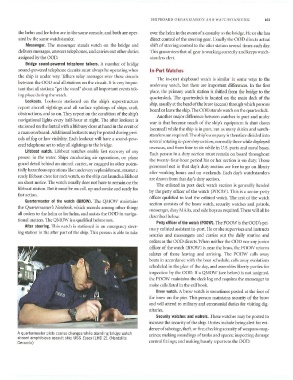
        A quartermaster plots course changes while standing bridge \.',atch   i:lzines;  mi:lking soundings of tanks and spaces; inspecting damage
        aboard amphibious assault ship USS  Essex (LHD 2). (Nardellto
        Gervaciol                                              control fittings; ilnd making hourly reports to the OOD.

