


Page 160 - NAVAL SCIENCE 3 TEXTBOOK
P. 160
Deck Seamanship


         Skills used  in  the  conduct of shipboard  evolutions stich  as  cargo   Before  a  seam,lIl  apprentice  (E-2)  can  become  a  striker  for
         handling. underway replenishment, and mooring. requiring the lISC   advancement to  il specialty rating,  he  or she  must  first  sat is!}'  the
         of lines, anchoring gear, and other such equipment, are collectively   requirements for seaman (E-3). To quali!}' for this rate, the E-2 must
         referred to as deck seamanship. As mentioned earlier, most of these   prove competent at mariinspike, deck, and boat seamanship. He or
         evolutions  are  carried  Ollt  by  personnel  of the  deck  department   she must be able to do these things to the satisfaction of the leading
         aboard large ships and the deck division aho<lrd smaller ships.   petty ollicers and division officer, receive their recommendation for
            \Ve  have already talked about the first  lieutenant in  <1n  earlier   advancement, and take a \\'ritten exam on deck Seanl<l11Ship.
         chapter Oil shipboard organization. That officer is in charge of the
         deck department or division. The title goes back to the carl)' da)'s
                                                                Boatswain's Mates
         of 13ritish  naval  sailing ships.  Then. the captain  was served  by a
         number of lieutenants. each in charge of a division. The first  liell~   The enlisted  supervisors of the deck force are  boatswain's  mates.
         tenant  was  the most senior and  knowledgeable in  the business of   They direct and train seamen  in  military duties tlnd  in aU  activi-
         working and maneuvering a man-of-war under sail.  He therefore   ties that have to do with marlinspike, deck, and boat seamanship.
         was the specialist in seamanship. This title has survived to this day.
         The first lieutenant, assisted  by  the ship's boatswain, is in  charge
         of all  deck seamanship evolutions, as well as the care and mainte-
         nance of Illost of the ship's exterior.


         Deck Personnel
         The personnelullder the first lieutenant who carr)' out most sea-
         manship  duties  are  members  of one  or  more  deck  divisions,
         depending upon the size of the ship. Most large surli1Ce ships have
         three deck divisions. The first  division has  charge of the forward
         part of the ship;  the second, the ship's boats and boat decks; and
         the third, the after part of the ship.
            On ships having aviation personnel  aboard, nonaviation per-
         sonnel,  especially those  in  the deck department, are traditionally
         referred to as "blacks hoes," while aviation persollnel are collectively
         called "brownshoes." These nicknames  refer to the shoe colors of
         surface line officers who wear black shoes, as opposed to naval avi-
         ators who by custom wear brown shoes with their khaki uniforms.
            The  seaman  apprentice  (SA)  reporting  on  board  ship  from
         boot camp (recruit tmining) is usually assigned to  OIlC of the deck
         divisions. These new personncl do the physical work that IllUSt be
         done b), the deck force in an)' ship. This includes  upkccp of ship's
         compartments,  living  areas,  decks,  and  ex1ernal SurJilCCS.  Also,  it
         includes the deck watches such as  helmsman, lookout, messenger
         under way and in port) and other special watches such as sentr)' dut),
         and anchor watches. During gener.]1 quarters, seamen are members
         of gun crews and damtlge control parties. During seamanship tasks,
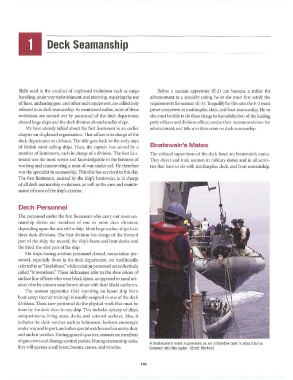
                                                                A boatswain's mate supervises as an  inflatable boat  is about to be
         they will  operate small boats, booms, cranes, and winches.   lowered  into the water.  (Brett Morton)


                                                            '66

