


Page 211 - NAVAL SCIENCE 3 TEXTBOOK
P. 211
RULES  OF THE  ROAD  AND l\I ANE UVERING  BOARD   217

                  a
                      shorCblast:  TOOT        ~
                                   ~  1   ONbll
                      prolonged:  T-O-O-T
                                 ~ + 6~ CONDS-loi
                      long: T-O-O-T
                            ~  B  10  ,eCoND'        '1


                                                             f


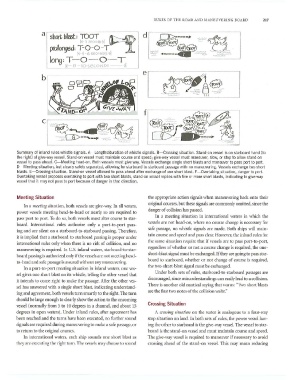
        Summary of inland rules whistle signals.  A-Lengths/duration of whistle signals.  B-Crossing situation.  Stand-on vessel  is on  starboard  hand  (to
        the right) of give-way vessel.  Stand-on vessel  must maintain course and speed; give-way vessel  must maneuver,  slow, or stop to allow stand-on
        vessel  to pass ahead.  C-Meeting head-on.  Both vessels must give way.  Vessels exchange single short blasts and  maneuver to pass port to port.
        O-Meeting situation,  but clearly safely separated,  allowing for starboard to starboard  passage with no maneuvering. Vessels exchange two short
        blasts.  E-Crossing situation. Stand-on vessel  allowed to pass  ahead  after exchange of one  short  blast.  F~Overtaking Situation,  danger to port.
        Overtaking vessel  proposes overtaking to  port with two short blasts,  stand-on vessel  replies 'Nith five  or more short blasts,  indicating to give-way
        vessel  that it may not pass  to  port  because of danger in that direction.


        Meeting Situation                                      the appropriate action signals when maneuvering back onto their
                                                               original courses, but these signals are commonly omitted, since the
           Tn  a meeting situation, both vessels arc  give~way. In  all waters,
                                                               danger of collision has passed.
        power vessels  meeting  head-to-head  or nearly  so  are  required  to
                                                                  In  a  meeting situation  in  international  waters  in  which  the
        pass  port to  port. To  do so, both vessels  must alter course to star-
                                                               vessels  are  not head-on,  where no course change  is  necessary for
        board.  International  rules  authorize  ani}'  a  port~to-port  pass-
                                                               safe  passage,  no  whistle signals are  made.  Both  ships will  main-
        ing and are silent on a starboard-to~starboard passing. Therefore,
                                                               tain course and speed and pass clear. However, the inland rules for
        it is implied that a starboard-to-starboard passing is  proper under
                                                               the same situation  require that  if vessels arc to  pass port-to-port,
        international rules only when  there is  no  risk of collision, and  no
                                                               regardless of whether or not a course change is  required, the one~
        maneuvering is  required.  In  U.S.  inland waters,  starboard~to-star~
                                                               short -blast signal must be exchanged. If they are going to pass star~
        board passing is authorized only if the vessels are not meeting head~
                                                               board to starboard, whether or  not change of course is required,
        to-head and safe passage is assured without any maneuvering.
                                                               the two-short-blast signal must be exchanged.
           In a port~to-port meeting situation in inland waters, one ves-
                                                                  Under both sets of rules,  starboard-to-starboard passages are
        sel gives one short blast on its whistle, telling the other vessel  that
                                                               discouraged, since misunderstandings can easily lead to a collision.
        it intends to come right to  make the passage. After the other ves-
                                                               There is another old nautical saying that warns: "Two short blasts
        sel  has answered with a single short blast, indicating understand-
                                                               are the first two notes of the collision waltz."
        ing and agreement, both vessels turn smartly to the right. The turn
        should be large enough to clearly show the action to the oncoming
                                                               Crossing Situation
        vessel  (normally from  5 to  10  degrees in a channel, and about  15
        degrees in open waters).  Under inland  rules, after agreement has   A crossillg situatioll  on  the  water  is  analogous  to  a  four-way
        been  reached and the turns have been executed, no further sound   stop situation on land. In  both sets of rules, the power vessel hav-
        signals are required during maneuvering to make a safe passage, or   ing the other to starboard is the give-way vessel. The vessel to star-
        to return to the original courses.                     board is the stand~on vessel and must maintain course and speed.
           In  international  waters,  each  ship  sounds one short blast as   The give~way vessel  is required to  maneuver if necessary to avoid
        thc}' arc executing the right turn. The vessels may choose to sound   crossing  ahead  of the  stand~on vessel.  This  may  mean  reducing

