


Page 209 - NAVAL SCIENCE 3 TEXTBOOK
P. 209
RU LES Or T HE  ROAD  AND :-'IANEUVER ING  BOAR D   21S

          Running Lights                                         Other Lights and Day S hapes
          \Vhite,  red,  and  green lights shown  by  all  vessels  under way  at   In  addition to the Ilormalunderw;'l), lights described above, there
          night  or in  pOOl' visibility conditions are called I"II/Illillg  lights. The   are  several  other  special  combinations of lights  and  day  shapes
          white light in the tore part of <l  ship is called the lIll1st},earllight; it   (geometric  shapes  like  balls,  cones,  and  diamonds,  made  from
          is  required for all oceangoing vessels, The white light 0 11  an after-  canvas stretched over metal ribbing)  for vessels engaged in certain
          Illast is called the mllge light; it is required only 011 vessels 50 meters   activities or in a special status.
          (  feet) or Illore in  length. The port sidelight is red, nnd  the star-  ~'Iost harbors require large ships to  take aboard il pilot who is
          board  sidelight  is green. A ,'esse!  under way  mllst  also  display a   thoroughly familiar with the harbor, berthing instructions. and the
          white stern light.                                     handling of local  tugboats. to take the ship into port. When enter-
             The purpose of these lights is to Wilrn vessels of the presence or   ing port at night. an  officer of the deck (OOll) or conning officer
          approach of other \tessels and to show in which direction they arc   of  a ship will wnnt to know the inst;'l11t the pilot boat is sighted so it
          going. On i.l  dark night, it is nearly impossible to see illl}'thing of a   ma), be signaled alongside. "White over red. pilot ahead" is the little
          ship or boat except the running lights. The sidelights Me arranged   memory aid  to use when  looking for  the special ideJlti~'ing lights
          so  that  when both the red  and  green  sidelights are seen, you are   of a power-driven pilot boal at night.
          looking at the bow. and the vessel  is hending directly toward you.   All  vessels  O\'el"  7 meters (23  feet)  long at anchor  must show
          \"'hen onl}' the green sidelight is seen, you are looking at the st .. 11"-  il11chor lights, according to the rules. Vessels less than 50 meters in
          board  side, somewhere from  the  bow to slightly behind the star-  length  ill  nnchor show <1n  all-around white light forward. If more
          board beam. When anI),  the red sidelight  is seen. )'on are looking   thiln 50 meters, n similar light aft must be shown also. The forward
          at the port side, somewhere from the bow to abaft the port beam.   light should be higher than  the onc aft. usuall),  on the top of the
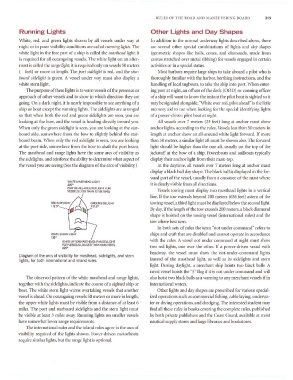
          The masthead  and  range lights have the same arcs  of visibility as   jackstall" at  the bow of a ship. Powerboats and sailboats typicall),
          the sidelights, and reinforce the ability to determine what aspect of   display their anchor light  from  their mast-top.
          the vessel you are seeing (See the diagram of the arcs of visibility.)   In  the daytime, all  vessels over 7 meters long at  anchor must
                                                                displa)' a black ball da), shapc. The black ball is displa),ed in the for-
                                                                ward part of the vcssel, usually from a crosstrec of the mast where
                              WHITE MASTHEAD UGHT
                              225'                              it is clearly visible frOlll all directiolls.
                              (MAY BE AlL·AROUND UGHT FOR
                              VESSELS LESS THAN 12 METERS)         Vessels  towing  mllst display  two  masthead  lights  in  a vertical
                                                                line. If the tow extends be)'ond 200 mcters (656  leet) astern of the
                       REO~OEUGHT      GREEN ~DEUGHT            towing vessel. a third light must be displayed below the second light.
                       112.5°           112.5°
                                                                By dOl),. if the Icngth of the tow exceeds 200 meters. a black diamond
                                                                shape  is hoisted on the towing vessel  (international  rules)  and  the
                                                                tow where best seen.
                                                                   In  both sets of rules the term "not under cOlllllland" refers to
                                /
                       WHilE STERN UGHT                         ships nnd craft that are disabled and cannol operate in accordance
                       135'
                            WHITE AFTER MASTHEAD (RANGE) LIGHT   with  the rules. A vessel  not under  cOIllIll~l1ld at  night must show
                            FDA VESSELS LQ,'1GER THAN 50 METERS
                            225'                                two  red  lights,  one over the other.  If a power-driven  vessel  with
                                                                headway,  the  vessel  mllst  show  the  not-under-command  lights
          Diagram of the arcs of visi bil ity for masthead,  sidelights,  and stern
                                                                instead  of the  masthead  light, as well  as  its sidelights and  stern
          lights,  for both international and  inland rules.
                                                                light. During da),light. a merchant ship  hoists two black  balls. A
                                                                nnv;.ll vessel hoists the "5" flag if it is not under command and ",ill
            The obsen'ed pattern of the white masthead and range lights,   also hoist two black balls as a warning to any merchant vessels if in
         together with the sidelights, indicate the comse of a sighted ship or   international waters.
         boat. The white stern  light warns overtaking vessels that another   Other lights and day shapes arc prescribed lor various special-
         \'esscI is ahead. On oceangoing vessels 50 meters or more in length,   ized operations such as cOlllmercial fishing, cable laying. underwa-
         the upper white lights must be visible from il distance of at lenst 6   ter or diving operations, ilnd dredging. The interested student may
          miles. The port and starboard sidelights ilnd  the stern light  must   find all these rules in books covering the complete rules, published
         be visible  nt  least 3 miles  away.  Running lights on smaller vessels   b)' both private publishers and the Coast Guard. ,wailable at  most
         have somewhat lower range requirements.                nautical supply stores and large libraries i1l1d bookstores.
            The international rules and the inland mil's agree in the i.lrCS of
         visibility  required of the lights shown. Power-driven  motorboats
         require similar lights, but the rnnge light is optional.

