


Page 208 - NAVAL SCIENCE 3 TEXTBOOK
P. 208
Nautical Rules of the Road


         The  nautical  traffic  laws  are  contained  in  severnl sets of rules.
         These  are  cOlllmonly  known  as  the  nautical  rules  of the  road.   -
         There are two main sets of rules:  the illlernalion~t1 rules, and the
                                                                )~S" GU~RO
         U.S. inland rules. Most provisions are idcntical, but there are some
                                                                I1.AB(lH CITY
         differences.

         Where Rules Apply

         The international rules must be obeyed by all vessels of all nations
         that  trowel  on  the high seas.  These  rules were  first  established  in
          1897  by all  the  maritime  I1ntiollS  of the  world.  There  have  been
         several major revisions since then, the latest of these being in  1972.
         The full official name for the internalioIl<l1 rules of the road is  Tile
         JlllemntiOlw/  Regll/(/fiolls for  Prcl'cllfil1g  Collisiolls  at  Sell,  1972,
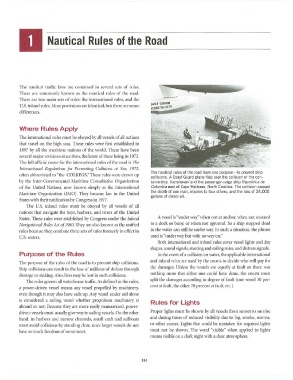
                                                                The nautical rules of the road  have one purpose- to  prevent ship
         often abbreviated to "the  COLREGS." These rules were drawn up
                                                                collisions.  A Coast Guard  plane flies over the collision of the con-
         b}'  the  Inter-GO\'ernll1cntal  lvlaritime  Consultativc  Organiz.1tion   tainership  Transhawaii and  the passenger-cargo ship Republica de
         of the  United  Nntiolls,  now  known simply as  the  Intefllntional   Colombia east of Cape  Hatteras, North Carolina.  The collision caused
                                                                the death of one man,  injuries to four others,  and the  loss of 24,000
         lvhuitime Organization  (iMO).  They  became  law  in  the  United
                                                                gallons of diesel oil.
         Stnte5 with their ratification by Congress in  1977.
            The  u.s.  inland  rules  must  be  obc)'ed  b)'  011  vessels  of 011
         nntions  that  navigate the bays,  harbors,  and  rivers of the  United
         St<ltes. These rules were established by Congress under the Jlllmui   A vessel  is "under way" when not at anchor, when not moored
         J\l(ll'igatiollnl Rilles Act of 1980. They are also known as the unified   to  a dock or buoy. or when  not aground. So  .1  ship stopped dead
         rules because they combine three sets of rules formerly in effect in   in the water can still be lInder way. In stich a situation, the phrase
         U.S. waters.                                           used is "under way but with no Wily on."
                                                                   Both  international and inland rules cover vessel lights and  day
                                                                shapes, sOllnd signals, steering and sailing rules, and distress signals.
         Purpose of the Rules                                      In the event of a collision on water, the applicable international
                                                                and inland rules are lIsed by the courts to decide who will pay for
         The purpose of the rules of the road is to prevent ship collisions.
                                                                the damages.  Unless  the  vessels  are  equally at  l~llIlt or there  was
         Ship collisions Ciln result in  the loss of millions of dollars through
                                                                nothing more  that  either one could  have  dOlle. the  courts must
         dalll<lge or sinking. Also, lives mily be lost in sllch collisions.
                                                                split the damages according to degree of lilllit  (one vessel  30 per-
            The rules govern all waterborne traffic. As defined in the rules,
                                                                cent ot fault, the other 70 percent ot "lllit, ctc.).
         a  power-driven  \'Cssel  means  any vessel  propelled  by  machinery,
         e\'cn though it Illay nlso  have snils up. Any vessC'lunder sail alone
         is  considered  a  sailing  vessel  whether  propulsion  machinery  is
                                                                Rules for Lights
         i.lboard  or not.  Because  they are Illore easily IlHlJlC'lI\'ered,  power-
         driven vessels Illust usually give way to sailing vessels. On the other   Proper lights must be shown by all  vessels  ti·Olll Sllllset to sunrise
         hand, in  harbors and  narrow channels,  small  craft  and sailboats   and during times of reduced  visibility due to  fog, smoke. storms,
         must avoid collisions by standing clear. since larger vessels do not   or other causes.  Lights that could  be mistaken for  required lights
         have as much freedom of nloveillent.                   nUlst  not  be  shown. The word  "visible" when  applied  to  lights
                                                                means visible on a dark night with a clear atmosphere.


                                                            214

