


Page 11 - NS-2 Textbook
P. 11
4                                                                                       MARITIME  HISTORY


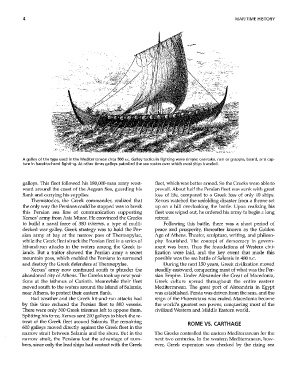
          A galley of the type used in the Mediterranean circa  500 B.C.  Galley tactics  in fighting were simple: overtake, ram or grapple, board, and cap-
          ture in hand-ta-hand fighting. At other times galleys patrolled the sea  routes over which most ships traveled.


          galleys. This fleet followed his l80,000-man army west-  fleet, which was better armed. So the Greeks were able to
          ward around the coast of the Aegean Sea, guarding his   prevail. About half the Persian fleet was sunk with great
          flank and carrying his supplies.                        loss of life, compared to a Greek loss of only 40  ships.
              Themistocles,  the  Greek  commander,  realized  that   Xerxes watched the unfolding disaster from a throne set
          the only way the Persians could be stopped was to break   up on a hill overlooking the battle.  Upon realizing his
          this  Persian  sea  line  of  communication  supporting   fleet was wiped out, he ordered his army to begin a long
          Xerxes' army from Asia Minor. He convinced the Greeks   retreat.
          to build  a  naval force  of 380  triremes,  a  type  of multi-  Following  this  battle,  there  was  a  short period  of
          decked war galley.  Greek strategy was to hold the Per-  peace  and prosperity,  thereafter  known as  the  Golden
          sian army  at bay at  the  narrow  pass  of Thermopylae,   Age of Athens. Theatel; sculpture, writing, and philoso-
          while the Greek fleet struck the Persian fleet in a series of   phy flourished.  The  concept  of  democracy  in govern-
          hit-and-run attacks in the  waters  among the  Greek is-  ment was born.  Thus the  foundations  of Western civi-
          lands.  But  a  traitor  showed  the  Persian  army a  secret   lization  were  laid,  and  the  key  event  that  made  this
          mountain pass, which enabled the Persians to surround   possible was the sea battle of Salamis in 480 B.C.
          and destroy the Greek defenders at Thermopylae.            During the next 150 years, Greek civilization moved
              Xerxes'  army now continued south to  plunder the   steadily eastward, conquering most of what was the Per-
          abandoned city of Athens. The Greeks took up new posi-  sian Empire. Under Alexander the Great of Macedonia,
          tions  at  the  Isthmus  of Corinth.  Meanwhile  their  fleet   Greek  culture  spread  throughout  the  entire  eastern
          moved south to the waters around the island of Salamis,   Mediterranean.  The  great port of Alexandria in Egypt
          near Athens, to protect their eastern flank.            was established. Persia was driven from the seas, and the
              Bad weather and the Greek hit-and-run attacks had   reign of the Phoenicians was ended. Macedonia became
          by  this  time  reduced  the  Persian  fleet  to  800  vessels.   the world's greatest sea power, conquering most of the
          There were only 300 Greek triremes left to oppose them.   civilized Western and Middle Eastern world.
          Splitting his force, Xerxes sent 200 galleys to block the re-
          treat of the Greek fleet  around Salamis. The remaining
                                                                               ROME VS.  CARTHAGE
          600 galleys moved directly against the Greek fleet in the
          narrow strait between Salamis and the shore. But in the   The Greeks controlled the eastern Mediterranean for the
          narrow strait,  the Persians lost  the  advantage of num-  next two centuries. In the western Mediterranean, how-
          bers, since only the lead ships had contact with the Greek   ever,  Greek  expansion  was  checked  by  the  rising  sea

