


Page 12 - NS-2 Textbook
P. 12
SEA  POWER AND EARLY WESTERN  CIVILIZATION                                                               5


                          IONIAN
                           SEA


                          o   25   ~O   75   [00
                                MILES              ~KITIURA


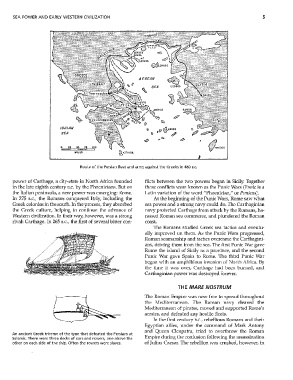
                                   Route of the Persian fleet and army against the Greeks in  480 B.C.


      power of Carthage, a city-state in North Africa founded   flicts between the two powers began in Sicily.  Together
      in the late eighth century B.C. by the Phoenicians. But on   these conflicts were known as the Punic Wars (Punic is a
      the Italian peninsula, a new pOV\Ter ,"vas emerging: Rome.   Latin variation of the word uPhoenician,H or PUllicllS).
      In 275  B.C.,  the Romans  conquered Italy,  including  the   At the begimling of the Punic Wars, Rome saw what
      Greek colonies in the south. In the process, they absorbed   sea power and a strong navy could do. The Carthaginian
      the  Greek  culture,  helping  to  continue  the  advance  of   navy protected Carthage from attack by the Romans, ha-
      Western civilization. In their way, however, was a strong   rassed Roman sea commerce, and plundered the Roman
      rival: Carthage. In 265  B.C., the first of several bitter con-  coast.
                                                                 The Romans studied Greek sea  tactics  and eventu-
                                                              ally improved on them. As the Punic Wars progressed,
                                                             Roman seamanship and tactics overcame the Carthagini-
                                                              ans, driving them from the sea. The first Punic War gave
                                                             Rome the island of Sicily as a province, and the second
                                                             Ptmic  War  gave  Spain  to  Rome.  The  third  Punic  War
                                                             began with an amphibious invasion of North Africa. By
                                                             the  time  it was  ove1;  Carthage had been burned,  and
                                                             Carthaginian power was destroyed forever.

                                                                           THE  MARE NOSTRUM

                                                             The Roman Empire was now free  to spread throughout
                                                             the  Mediterranean.  The  Roman  navy  cleared  the
                                                             Mediterranean of pirates, moved and supported Rome's
                                                             armies, and defeated any hostile fleets.
                                                                 In the first century B.C., rebellious Romans and their
                                                             Egyptian  allies,  under  the  command  of Mark Antony
                                                             and  Queen  Cleopatra,  tried  to  overthrow  the  Roman
      An  ancient Greek trireme of the type that defeated the Persians  at
      Salamis. There were three decks of oars and  rowers,  one above the   Empire during the confusion following the assassination
      other on each side of the ship.  Often the rowers were slaves.   of Julius Caesar. The rebellion was crushed, huwever, in

