


Page 14 - NS-2 Textbook
P. 14
SEA  POWER AND EARLY WESTERN  CIVILIZATION                                                              7


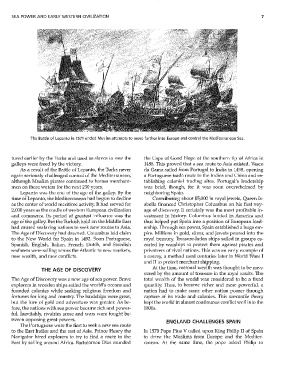
              The Battle of Lepanto in  1571  ended Muslim  attempts to move farther into Europe and control the Mediterranean Sea.


      tured earlier by the Turks and used as slaves to row the   the Cape of Good Hope at the southern tip of Africa in
      galleys were freed by the victory.                     1488. This proved that a sea route to Asia existed. Vasco
         As a result of the Battle of Lepanto, the Turks never   da Gama sailed from Portugal to India in 1498, opening
      again seriously challenged control of the Mediterranean,   a Portuguese trade route to the Indies and China and es-
      although Muslim pirates continued to harass merchant-  tablishing  colonial  trading  sites.  Portugal's  leadership
      men on these waters for the next 250 years.            ,vas  brief,  though,  for  it  ·was  soon  ovenvhelmed  by
         Lepanto was the end of the age of the galley. By the   neighboring Spain.
      time of Lepanto, the Mediterranean had begun to decline    Contributing about $5,000 in royal jewels, Queen Is-
      as the center of world maritime activity. It had served for   abella financed  Christopher Columbus on his first voy-
      2,000 years as the cradle of western European civilization   age of discovery. It certainly was the most profitable in-
      and commerce. Its period of greatest influence was the   vestment in history.  Columbus landed in America and
      age of the galley. But the Turkish hold on the Middle East   thus helped put Spain into a position of European lead-
      had caused seafaring nations to seek ne'iY routes to Asia.   ership. Through sea power, Spain established a huge em-
      The Age of Discovery had dawned. Columbus laid claim   pire. Millions in gold, silver, and jewels poured into the
      to  the  New World  for Spain in  1492.  Soon Portuguese,   royal treasury. Treasure-laden ships sailed in groups es-
      Spanish,  English,  Italian,  French,  Dutch,  and  Swedish   corted by warships to protect them against pirates and
      seafarers ,vere sailing across the Atlantic to ne,v markets,   privateers of rival nations. TI1is ·was an early example of
      new wealth, and new conflicts.                         a Co/lDOY,  a method used centuries later in World Wars I
                                                             and II to protect merchant shipping.
                                                                 At the time, national wealth was thought to be mea-
                  THE AGE  OF  DISCOVERY
                                                             sured by the amount of treasure in the royal vaults. The
      The Age of Discovery vvas a new age of sea power. Brave   total wealth of the world was considered  to be a fixed
      explorers in wooden ships sailed the world's oceans and   quantity. Thus, to become richer and more powerful, a
      founded  colonies  while  seeking religious freedom  and   nation had to make some other nation poorer through
      fortunes for king and cotmhy. The hardships were great,   capture of its  h·ade  and colonies.  This  mercalltile  theory
      but the lure of gold and adventure was greater. As be-  kept the world in almost continuous conflict well into the
      fore, the nations with sea pmver beCan1€ rich and power-  1800s.
      ful.  Inevitably, rivahies arose and ,vars 'were fought be-
      tween opposing great powers.
                                                                       ENGLAND CHALLENGES  SPAIN
         The Portuguese were the first to seek a ne,v sea route
      to the East Indies and the rest of Asia. Prince Henry the   In 1570 Pope Pius V called upon King Philip II of Spain
      Navigator hired explorers  to  try  to  find  a  route  to  the   to  drive  the  Muslims  from  Europe  and  the  Mediter-
      East by sailing around Africa. Bartolomeu Dias rotmded   ranean.  At  the  same  time,  the  pope  asked  Philip  to

