


Page 113 - NS-2 Textbook
P. 113
106                                                                                      MARITIME HISTORY


         ing, and resupply of Japanese troops on the island was       THE  SUBMARINE WAR IN THE PACIFIC
         becoming  more  difficult.  Extremely  heavy  casualties
                                                                The  submarine war in the Pacific "vas  in filany ",.,rays  a
         were inflicted on troop reinforcements by destroyers and
                                                                mirror image of the Battle of the Atlantic. In the Atlantic
         PT boats.
             The marines ashore continued their hard-fought ad-  it was  the  goal  of  German U-boats  to  interdict Allied
                                                                shipping in order to strangle Britain, but in the Pacific the
         vance, pushing the Japanese into the jtmgle interior. Fi-
                                                                roles ,vere reversed. It \vas the Alnerican submarines that
         nally, on 9 February 1943 the Japanese slipped out of the
         jungle, and 12,000 hall-starved survivors made an escape   attempted to gain a stranglehold against Japanese ship-
                                                                ping. In this endeavor they were aided somewhat by the
         on fast destroyers. Guadalcanal was secured.
                                                                Pacific geography, where shipping lanes  to Japan from
                                                                their sources of supply in Malaya, Borneo, Sumatra, and
           STRATEGY OF  1943: CONTINUOUS PRESSURE
                                                                Java  'were  often  located  in  narroV\T  straits  behveen  is-
                                                                lands.  This made interdiction easier for American sub-
         A consolidation and planning period took place follow-
         ing the success on Guadalcanal and other successes on   marines  than for  their German counterparts in the At-
                                                                lantic. To build up the munbers of submarines, they were
         New Guinea. Events in Europe dictated that it would be
                                                                mass-produced during the war by American shipyards,
         mainly up to u.s. forces, assisted when possible by Aus-
         tralian and New Zealand (ANZAC) forces, to prosecute   just as  escort  destroyers  and Liberty  and Victory mer-
                                                                chant ships were. For the Pacific, specially designed big
         the war in the Pacific against the Japanese. The program
                                                                submarines,  nearly  twice  the  size  of German  V-boats,
         put into effect for  the rest of 1943 and early 1944 called
         for the elimination of the Japanese outposts in the Aleu-  were developed to carry greater fuel and torpedo loads
                                                                for long-distance patrols against the Japanese.
         tians; intensified submarine attacks on the Japanese lines
                                                                    The Japanese, on the other hand, never placed much
         of communication from the Indies; and the isolation of
         Rabaul, with MacArthur's forces  assisted by the South   emphasis on their submarine fleet. Their subs mainly tar-
                                                                geted warships rather than auxiliary and merchant ship-
         Pacific  naval  forces.  A two-pronged advance across  the
                                                                pmg. In general they underestimated the potential of the
         Pacific would then follow, with the objective of reaching
         the Luzon (northern Philippines)-Formosa-China coast   submarine  throughout  the  war.  This  philosophy  had
                                                                been reinforced by the poor showing of their submarines
         geographic  triangle  by  late  1944.  From  there,  attacks
                                                                at Pearl Harbor and during the early months of the war.
         against  the Japanese  home  islands could be latmched.
         One line of advance would proceed across the central Pa-  Though they had some successes, they were insignificant
                                                                compared to the effectiveness of the U.S. submarines in
         cific by way of the Gilberts, Marshalls, Marianas, Caro-
                                                                the conflict.
         lines,  and  Palaus  toward  the  Philippines  or  Formosa,
         using naval forces commanded by Nimitz. The other line     Making the sihmtion worse for the Japanese was the
                                                                fact that their antisubmarine operations 'were never velY
         of advance would be across the Southwest Pacific via the
                                                                successful  either.  Because  of  a  general  lack  of  escort
         north coast of New Gumea to the southern Philippines,
                                                                ships,  the Japanese were not able  to  adopt the  convoy
         using combined U.S. and Allied forces tmder the overall
                                                                techniques that were so successful in the Atlantic against
         command of MacArthur. In the early part of 1943 there
         was  also  hope  that the  Nationalist Chinese  army and
         other Allied  forces  tmder  Chiang Kai-shek,  the  Allied
         commander in the China theater, could fight  their way
         through  Burma  to  the  Chinese  coast  as  well.  Later  in
         the year, hmvever, these hopes were abandoned ,vhen it
         became obvious that the poorly equipped and badly or-
         ganized Chinese army would not be able  to  overcome
         the stiff resistance of Japanese occupational forces in the
         region.
             The reconquest of Athl and Kiska in the Aleutian Is-
         lands took place over  the SlUnmer months of 1943.  By
         August the Aleutians had been fully rehlrned to Ameri-
         can control, and they were never again threatened by the
         Japanese.  Grotmd forces  used in the attacks were rede-
         ployed to the central Pacific. TIlOugh some thought was
         given to  establishing a  third line of advance across the
         North Pacific via  these islands,  the Joint Chiefs finally
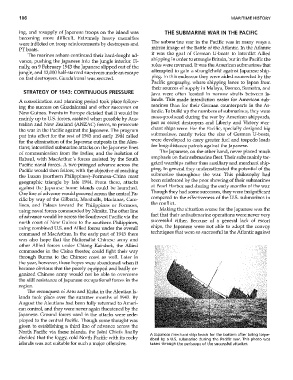
                                                                A Japanese merchant ship heads for the bottom after being torpe-
         decided that the foggy, cold North Pacific with its rocky   doed  by  a  U.S.  submarine  during  the  Pacific  war.  This  photo was
         islands was not suitable for such a major offensive.   taken through the periscope of the successful  attacker.

