


Page 118 - NS-2 Textbook
P. 118
WORLD WAR II: THE  PACIFIC WAR                                                                        111

      8-square-mile  island  of  lava  cut  into  hills  and ravines,   the edge of the nearest airfield. Of 30,000 marines who
      overlooked by 550-foot Motmt Suribachi, an extinct vol-  hit the beach that first day, 2,400 became casualties.
      cano. The Japanese tunneled into the volcanic rock and     The  fighting  continued  through the night,  and  the
      made  interconnecting  passageways  behveen  400  con-  next day the airfield was captured. The assault on Mount
      cealed pillboxes and concrete blockhouses. Their artillery   Suribachi  then began.  After three  days of blasting and
      was placed in caves on Mount Suribachi, where it could   burning  out  pillboxes  and  sealing  up  caves  with
      sweep the beaches.                                      grenades,  flamethrowers,  rockets,  and  demolition
          VVhen  the invasion force arrived, heavy naval bom-  charges,  the  mountain  was  surrounded  and  a  patrol
      bardment on the island was able to be conducted for only   reached  the  summit and raised  the American flag.  By
      three days of the ten requested by the marines, because   good fortune the flag raising was photographed by a war
      of the accelerated timetable decreed by the Joint Chiefs of   correspondent. A life-sized sculpture later made from the
      Staff. This was to prove grossly inadequate.            photo immortalized the moment and has provided in-
          D day at Two Jima was set for 19 February 1945. Five   spiration ever since to the American people. The sculp-
      hundred  landing  craft  carrying  eight  battalions  of   ture is now located in Washington, D.C.
      marines  moved  to  the  line  of  departure.  Meanwhile,   While  the  vicious fighting ·was  in progress  on hvo
      more than a hundred of TF-58's planes attacked the is-  Jima, the supporting naval forces of TF-58 and the Am-
      land with rockets, machine guns,  and general purpose   phibious Support Force were hit by numerous kamikaze
      and napalm bombs. Naval guns shifted from  slow, de-    attacks. The carrier Saratoga was badly damaged, and the
      structive  fire  to  fast,  neutralizing fire  to  drive  the  de-  escort carrier Bismarck Sea  sank after a  tremendous ex-
      fenders  underground.  When  the  assault  waves  ap-  plosion that blew off her stern.
      proached the beach, the support ships shifted fire again
      to provide a barrage of fire ahead and on the flanks of the
      advancing  marines.  More  than  fifty  rocket-firing  am-
      phibious ships advanced to give the marines close sup-
      port.
          Despite all  this  preparatory fire,  the  assault waves
      quickly piled up on the beach because  the  amphibian
      tractors were unable to climb the crumbling volcanic ash.
      Many landing  craft broached  (turned  sideways  in  the
      surf)  or  ran  into  earlier  boat  waves.  The  lllarines,
      stranded on the steep beach, soon were hit by withering
      machine-gtm, mortar, and heavy gurtfire from weapons
      that had withheld their fire earlier so they would not re-
      veal their positions. Through this holocaust the marines
      inched forward, isolating Motmt Suribachi and reaching


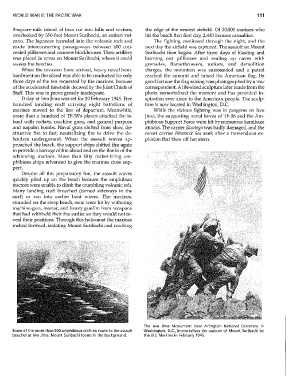
                                                             The  Iwo  Jima  Monument  near  Arlington  National  Cemetery  in
      Some of the more than 500 amphibious craft en route to the assault   Washington,  D.C.,  immortalizes the capture of Mount Suribachi  by
      beaches at Iwo Jima. Mount Suribachi  looms in the background.   the u.s.  Marines in February  1945.

