


Page 115 - NS-2 Textbook
P. 115
108                                                                                      MARITIME  HISTORY


         against Saipan in the central Pacific. The mammoth task   enemy  planes  from  advantageous  altitudes  and  direc-
         of  projecting  127,000  troops  on  535  ships  some  3,000   tions. The superbly trained American pilots, at peak effi-
         miles from Pearl Harbor, and providing them with fast   ciency after a year of successful combat experience, \vere
         carrier  task  force  support  against  the  entire  Japanese   ready for the battle.
         Fleet, was just as complex as the D Day invasion in Eu-    In eight haUl'S  of furious  air warfare,  330 Japanese
         rope.                                                  planes were shot down in what historians came to call
             As the amphibious task force  proceeded toward its   the  "Marianas  Turkey  Shoot."  At  the  same  time,  the
         objective, Army planes from the newly won bases in the   American  submarine  Albacore  torpedoed  OZa\va's  new
         Marshalls and Navy carrier planes from  Task Force 58   carrier flagship, the Taiho, and the submarine Cavalla put
         struck Japanese bases in the Marianas and in the Caro-  three torpedoes into the carrier SllOkakll.  Both carriers ex-
         lines. A bombardment by U.S.  battleships began on 13   ploded  a  few  haUl'S  later  with  great  loss  of  life.  But
         June. It continued until the fifteenth, when two Marine   Ozawa and his staff survived and transferred to the car-
         divisions crossed the coral reef through passages blasted   rier Zllikakll.
         by underwater demolition teams and hit the beaches.        Ozawa  ordered  a  general  retirement  to  refuel,  in-
             Heavy casualties were sustained, but by the end of   tending to resume battle the next day -even though he
         the  day  20,000  marines  were  ashore.  Reinforcements   had only 100  carrier planes left.  He believed erroneous
         were put ashore, and by 17 June the American offensive   reports  from  his  SUl'viving  pilots  that  TF-58  had been
         had captured the  main airfield and begun to  push the   crippled.
         Japanese back. By this time the Japanese Combined Fleet    Mitschel~ in the meantime, had received no informa-
         was  approaching  the  operating  area,  and  Admiral   tion  on  Ozawa's  movements  and  chose  a  course  that
         Mitscher had to stearn  out to  place himself between it
         and the forces on Saipan.


                  BATTLE  OF THE  PHILIPPINE  SEA
         Maneuvering  went  on  for  hyo days  as  the  hvo forces
         searched for each other. Mitscher was always mindful of
         his  primary  orders:  "Capture,  occupy,  and  defend
         Saipan, Tinian, and Guam." On the afternoon of 18 )tme
         Admiral Ozawa's scout planes discovered Task Force 58.
             Ozawa's main body had 6  carriers  surrounded by
         cruisers and destroyers in  two circular formations.  One
         htmdred nilles ahead of the main body was Vice Admi-
         ral Takeo KUl'ita with the main Japanese surface force of
         battleships and cruisers, and 3 carriers. Facing the Japa-
         nese Mobile Force of 9 carriers, 5 battleships, 13 cruisers,
         28 destroyers, and 430 carrier aircraft was Task Force 58
         with 15 carriers, 7 battleships, 21 cruisers, 69 destroyers,
         and 891 carrier aircraft. From Japan, Admiral Toyoda ra-
         dioed Ozawa that "the fate of the Empire depends on the
         issue of this battle; let every man do his utmost!"
             Ozawa had counted heavily on getting air support
         from the Marianas bases. He felt that this land-based air
         support  would  more  than  equalize  the  opposing  task
         forces.  Unfortunately for Ozawa, he did not know that
         only thirty operational planes remained after the devas-
         tating American raids made earliel; and that many of his
         carrier pilots had retUl'ned from the Biak operations sick
         with  malaria.  Not  aware  that  the  odds  were  heavily
         against him because of these factors, he moved to close
         with Task Force 58.
             Alerted to the impending attack, Mitscher and Spru-
         ance put more than 450 planes in the air to meet the chal-
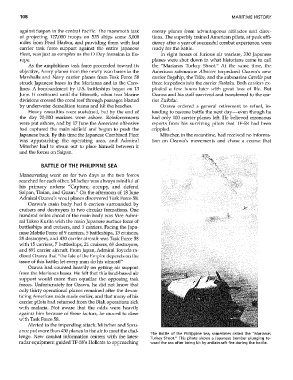
                                                                The  Battle  of the  Philippine  Sea,  sometimes  called  the  "Marianas
         lenge.  New combat information centers with the latest   Turkey Shoot."  This  photo shows a Japanese  bomber plunging  to~
         radar equipment guided TF-58's Hellcats to approaching   ward the sea after being hit by antiaircraft fire  during the battle.

