


Page 143 - NS-2 Textbook
P. 143
136                                                                                      MARITIME  HISTORY


             Even  before  the  u.s.  withdrawal  from  Vietnam             THE  MAYAGUEZ INCIDENT
         sweeping changes were being planned in personnel pol~
                                                                A month after the last Americans left South Vietnam  on
         icy,  administration,  technology,  and  weapons  in  the
                                                                12 May 1975 a disabled American merchant ship, th~ SS
         Navy. The old Navy bureau organization was changed to
                                                                Mayaguez, was seized in international waters off Cambo-
         five  material systems commands in  the interest of im-
                                                                dia by the Khmer Rouge, who had seized power in that
         proving efficiency and keeping up with the rapid pace of
                                                                country a few weeks earlier. TI,e exact reason why they
         technological advances. TI,ese commands-Air Systems,
                                                                did  this  has never been  determined.  They  then began
         Sea Systems, Electronics Systems, Supply Systems, and
                                                                towing the ship toward Kompong Sam on the mainiand.
         Facilities  Engineering-were placed under the  chief of
                                                                When President Gerald Ford was told of the developing
         naval material. That chief, along with the chief of naval
                                                                incident, he was determined that this would not become
         personnel and the chief of the Bureau of Medicine and
                                                                another hostage situation similar to the Pueblo incident in
         Surgery,  reported  directly  to  the  chief of naval opera-
                                                                1968. He ordered the carrier Coral Sea and the destroyers
         tions.
                                                                USS Hellry B.  WilSall  and USS Holt to steam at full speed
             In  the early  1970s  a  program  to  update many per-
                                                                to the Gulf of Thailand to rescue the ship and its crew.
         sonnel administrative practices was initiated by Admiral
                                                                Meanwhile the ship was spotted anchored off Kho Tang
         Zumwalt, who was, at the age of forty-nine, the youngest
                                                                Island, 40 miles from the Cambodian shore. The Holt was
         CNO in the history of the Navy. He made many changes,
                                                                directed to proceed there to seize the ship, while a force
         promulgated by means of a series of directives called "Z-
                                                                of  marines  airlifted  from  Okinawa  would  rescue  the
         Grams." Beards, more liberal hairstyles, civilian clothes
                                                                crew, believed to be held on the island.
         on liberty,  motorcycles  on bases,  and other departures
                                                                    On the morning of 15 May the first of an eventual 250
         from tradition excited many of the younger people and
                                                                marines were landed by helicopter on Kho Tang.  They
         worried  older  hands.  In  some  instances  the  rapid
                                                                immediately began to encounter heavy resistance from
         changes institnted by the new CNO caused confusion,
                                                                Khmer Rouge  troops  there.  While  this firefight was in
         necessitating  more  moderate  courses  of  action  to  be
                                                                progress, planes from  the  Coral  Sea  bombed targets  on
         adopted by later CNOs. Efforts were instituted to make
                                                                the  mainland.  This  action  apparently  convinced  the
         the Navy more attractive to  women and minorities, and
                                                                Khmer Rouge that they had wlderestimated u.s. resolve.
         these met with much success after some initial setbacks.
                                                                Soon a fishing boat was seen approaching the destroyer
                                                                WilSall  flying  a white flag. Aboard were the fuirty-nine
                                                                crewmen of the Mayaguez.  At almost the  same  time,  a
                                                                boarding  party  from  the  Holt  boarded  the  deserted
                                                                Mayaguez  and towed her to safety. That night the last of
                                                                the Marine attack force was successfully airlifted off the
                                                                island  by  Air  Force  helicopters.  Altogether  eighteen
                                                                marines and airmen were killed or Inissing in action dur-
                                                                ing the assault and withdrawal from Kho Tang. Another
                                                                twenty-three  were killed  in a  helicopter crash on their
                                                                "vay to  the operation. At a time when its resolve was in
                                                                doubt  following  the  debacle  in  Vietnam,  the  incident
                                                                showed  the  world  that  the  United  States  would  pay
                                                                vvhatever price ,vas necessary to protect its citizens and
                                                                preserve its national honor.
                                                                              THE  FALKLANDS WAR
                                                                In early 1982 a  major maritime event took place in the
                                                                South Atlantic off the coast of Argentina, when the Falk-
                                                                land Islands, long  the  subject of an ownership dispute
                                                                behveen Britain  and Argentina}  'vere taken over by  an
                                                                Argentine occupation force  on 2 April. In response, the
                                                                British, whose colonists had occupied the islands since
                                                                1833, gathered an invasion force  consisting of two ski-
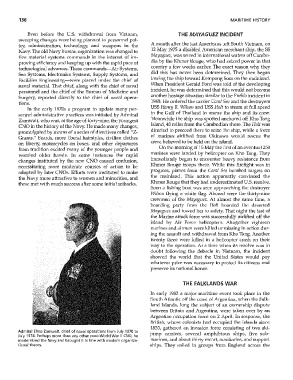
         Admiral Elmo Zumwalt, chief of naval operations from July  1970 to
         July 1974. Perhaps more than any other post-World War Jl  (NO  he   jump  carriers,  several  amphibious  ships,  five  sub-
         modernized the Navy and brought it  in line with modern organ'iza-  marines, and about thirty escort, auxiliaries} and support
         tiona I theory.                                        ships.  They sailed  in  groups  from  England  across  the

