


Page 142 - NS-2 Textbook
P. 142
THE  COLD WAR ERA                                                                                     135

           On the military side, the years of training of the offi-
        cer  corps  and  noncommissioned  officers  by American
        advisers were beginning to yield results. Many elements
        of  the  South Vietnamese  forces  had been  transformed
        into  efficient  fighting  organizations.  Navy,  sea  com-
        mando, and air force elements "vere considered the best,
        but there also were excellent army units. A fine system of
        military  bases  and  facilities,  fuel  dumps,  communica-
        tions equipment, and a huge supply system had been de-
        veloped  and  gradually turned over  to  the South Viet-
        namese. Almost all of the riverine and patrol craft were
        turned  over  to  the  South  Vietnamese  navy.  American
        forces had been reduced by half by the middle of 1971,
        and less than 150,000 were still in Vietnam by the end of
        that year. The Seventh Fleet started to reduce the number
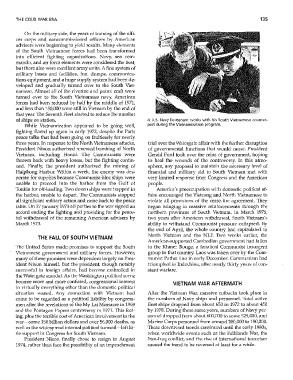
        of ships on station.                                   A  U.S.  Navy  lieutenant works  with  his  South  Vietnamese  counter-
           While  Vietnamization  appeared  to  be  going  well,   part during the Vietnamization program.
        fighting flared up again in early 1972,  despite the Paris
        peace talks that had been going on fruitlessly for nearly
        three years. In response to the North Vietnamese attacks,   trial over the Watergate affair with the further disruption
        President Nixon authorized renewed bombing of North    of governmental functions  that would cause.  President
        Vietnam,  including  Hanoi.  The  Communists  ",,'ere   Gerald Ford took over the reins of government, hoping
        thrown back with heavy losses, but the fighting contin-  to  heal  the  wounds  of  the  controversy.  In  this  atmo-
        ued.  Finally,  the  president  authorized  the  mining  of   sphere, any proposal to maintain the necessary level of
        Haiphong Harbor. Within a week, the enemy was des-     financial  and  military  aid  to  South Vieh1am  met  with
        perate for supplies because Communist-bloc ships were   very linllted response from Congress and the American
        unable  to  proceed  into  the  harbor  from  the  Gulf  of   people.
        Tonkin for off-loading. Two dozen ships were trapped in    America's preoccupation with domestic political af-
        the harbor, unable to depart. The Communists stopped   fairs encouraged the Vietcong and North Vietnamese to
        all significant military action and came back to the peace   violate  all provisions of the  cease-fire  agreement.  They
        table. On 27 January 1973 all parties to the war signed an   began bringing in massive  reinforcements  through  the
        accord ending the fighting and providing for the peace-  northern  provinces  of  South  Vietnam.  In March 1975,
        ful  withdrawal of the remaining American advisers by   two years after American withdrawal, South Vietnam's
        March 1973.                                            ability to withstand Communist pressure collapsed.  By
                                                               the end of April, the whole country had capitulated to
                                                               North  Vietnam  and  the  NLF.  Two  weeks  earlier,  the
                 THE  FALL OF  SOUTH VIETNAM
                                                               American-supported Cambodian government had fallen
        The United States made promises to support the South   to  the Khmer Rouge,  a  fanatical  Communist insurgent
        Vietnamese  government  and  military  forces.  Hm.vever"   group in that country. Laos was taken over by the Com-
        many of these promises were dependent largely on Pres-  mlmist Pathet Lao in early December. Communism had
        ident Nixon himself.  But the president, though notably   triumphed in Indochina, after nearly thirty years of con-
        successful  in  foreign  affairs,  had become  embroiled in   stant warfare.
        the Watergate scandal. As the Washington political scene
        became more and more confused, congressional interest
                                                                          VIETNAM WAR AFTERMATH
        in virtually everything other than the domestic political
        situation  waned.  Any  connection  with  Vietnam  had   After the Vietnam War,  massive cutbacks took place in
        come to be regarded as  a political liability by congress-  the numbers of Navy ships and personnel. Total active
        men after the revelations of the My Lai Massacre in 1969   fleet ships dropped from about 650 in 1972 to about 450
        and the Pentagon Papers controversy in 1971. This feel-  by 1978. During these same years, numbers of Navy per-
        ing, plus the terrible cost of American involvement in the   sonnel dropped from about 600,000 to some 525,000, and
        war-some 150 billion dollars and over 56,000 deaths, as   Marine Corps personnel from arOlmd 200,000 to 190,000.
        well as the Widespread internal political turmoil-left lit-  These downward trends continued until the early 1980s,
        tle support in Congress for South Vietnam.             when worldwide events such as the Falklands War,  the
           President  Nixon  finally  chose  to  resign  in August   Iran-Iraq conflict, and the rise of international terrorism
        1974, rather than face the possibility of an impeachment   caused the trend to be reversed at least for a while.

