


Page 144 - NS-2 Textbook
P. 144
THE  COLD WAR ERA                                                                                     137


                                              Rivadavio


                                          ARGENTINA


                                                         Atlantic
                                                          Ocean


                                                     Gollegos       WesiFa.  n
                                                                          1"'Ia~~Ea. 51 Falkland
                                                                                         Stanley
                                                                           Falklandislclnds


                       Pacific
                        Ocean

                                                                         o                      300
                                                                                   MilES


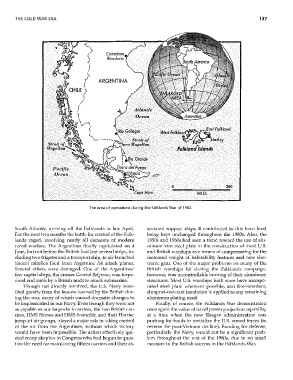
                                       The area of operations during the Falklands War of 1982.


       South Atlantic,  arriving off the Falklands in late April.   sociated support ships. It contributed to this force level
       For the next two months the battle for control of the Falk-  being kept unchanged  throughout  the 1980s.  Also,  the
       lands  raged,  involving  nearly  all  elements  of  modern   1950s and 1960s had seen a trend toward the use of alu-
       naval warfare.  The Argentines  finally  capitulated on 4   minum vice steel plate in the construction of most U.S.
       June, but not before the British had lost several ships, in-  and British warships as a means of compensating for the
        cluding two frigates and a h'ansport ship, to air-launched   increased  weight of habitability  feahrres  and new elec-
       Exocet missiles fired  from  Argentine A4  attack  planes.   tronic gear.  One of the major problems on many of the
       Several  others  were  damaged.  One  of the Argentines'   British  warships  hit  during  the  Falklands  campaign,
       few capital ships, the cruiser Gel1eral Belgral1o, was torpe-  howevel~ ·was tfficonh'ollable burning of theil' aluminum
        doed and sunk by a British nuclear attack submarine.   structUT€S.  Most U.S. ,varships built since have incorpo-
           TIlough not directly involved, the U.S.  Navy bene-  rated  steel plate wherever possible,  and  fire-retardant,
       fited greatly fTOm  the lessons learned by the British dm-  shrapnel-resistant insulation is applied to any remaining
       ing the war, many of which caused dramatic changes to   aluminum plating used.
       be implemented in our Navy. Even though they were not      Finally,  of course, the Falklands War  demonstrated
       as capable as our large-deck carriers, the two British car-  once again the value of naval power pTOjection capability
       riers, HMS Hermes and HMS Invincible, and their Harrier   at  a  time  when  the  new  Reagan  administration  was
       jump-jet air gTOUps, played a major role in taking control   pushing for funds to revitalize the U.s. armed forces (to
       of  the  air  from  the Argentines,  without which victory   reverse the post-Viemam decline).  Funding for  defense,
       would have been impossible. The action effectively qui-  particularly  the Navy, would not be a significant pTOb-
       eted many skeptics in Congress who had begun to ques-   lem throughout  the  rest of the  1980s,  due in no  small
        tion the need for maintaining fifteen carriers and their as-  measure to the British success in the Falklands War.

