


Page 183 - NS-2 Textbook
P. 183
176                                                                                            LEADERSHIP

              •  An explanation of the importance of the work          spected  as  an  individual who  has  somethiug  to
              •  A question about how the activity can be improved     contribute.
              •  A remark regardiug similar activities               •  Do not interrupt continually -with insignificant cor-
              •  A question about their earlier experience with sim-   rections or arguments.
               ilar work                                             •  Do not belittle the speaker's experiences, plans, ac-
                                                                       complishments, or possessions with greater  ones
             Any of these startiug points can lead iuto other top-     of your O'iNTI.
          ics,  if  the  leader  is  siucerely  iuterested  iu  gettiug  ac-  •  Probably one of the worst thiugs a listener can do
          quaiuted and will listen well.                              is to tell other people what they mean, or to antic-
                                                                      ipate  the  poiut  of  their  story  when  they  have
          Listel1il1g.  Listeniug  is  a  skill  the  effective  leader  must   scarcely begun. This is not only discourteous, but
          have. Few thiugs make a person feel so important or so      it can also  keep  one from  gettiug  the vital  facts.
          good  about  themselves  as  really  beiug  listened  to  by   Give the speaker a chancel even if you know what
          someone they admire or respect. It takes willpower and      he or she is driving at.
          practice to forget about personal problems, or other con-
          cerns, when trying to listen to someone. It simply is not   El1dil1g a COl1versatiol1. Ending a conversation is almost as
          possible to listen to a person while thiuking about some-  important as starting or keepiug one goiug.  The leader
          thing else. Thiukiug about other thiugs is bound to show   should not abruptly end a conversation that he or she has
          through even if you try to follow the person's story with   started.  Endiug  a  conversation  without  damagiug  the
          smiles, frowns} and other signs.                       pride or feelings of the other fellow is an art every leader
             Everyone can become a good listener. These are some   should  develop.  Consideration  and  good listeniug  are
          hiuts that should help.                                the keys to this art.
                                                                    Once a leader becomes known for beiug williug to
             •  Stop workiug when someone is talking to you; not   listen, haviug an open miud, a  good memory,  and  the
               to do so can be considered insultiug and is a sure   ability to grasp the poiut and settle problems, the person
               way of ruining a conversation.                    who may be iucliued to talk too much will shorten his or
             •  Accept the speaker as a fellow human beiug with   her chatter. Others, grateful for the attention they know
               an iuteresting personality. While the courtesies of   they will get, will respect the leader's time, make their
               rank should be observed, the speaker must be re-  pitch, and depart.


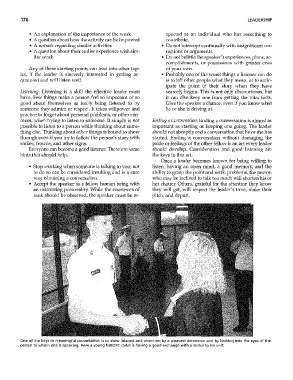
          One of the keys  to meaningful conversation  is  to show interest and  attention by a pleasant demeanor and  by  looking  into the eyes of the
          person to whom one is  speaking.  Here a young  NJROTC cadet is  having a good exchange with a visitor to his  unit.

